Last Commandant
The last commandant of the fort, belong to Vanjari, who died a few years ago, must, like his predecessor, have wrought this nationalization of Portuguese names.”
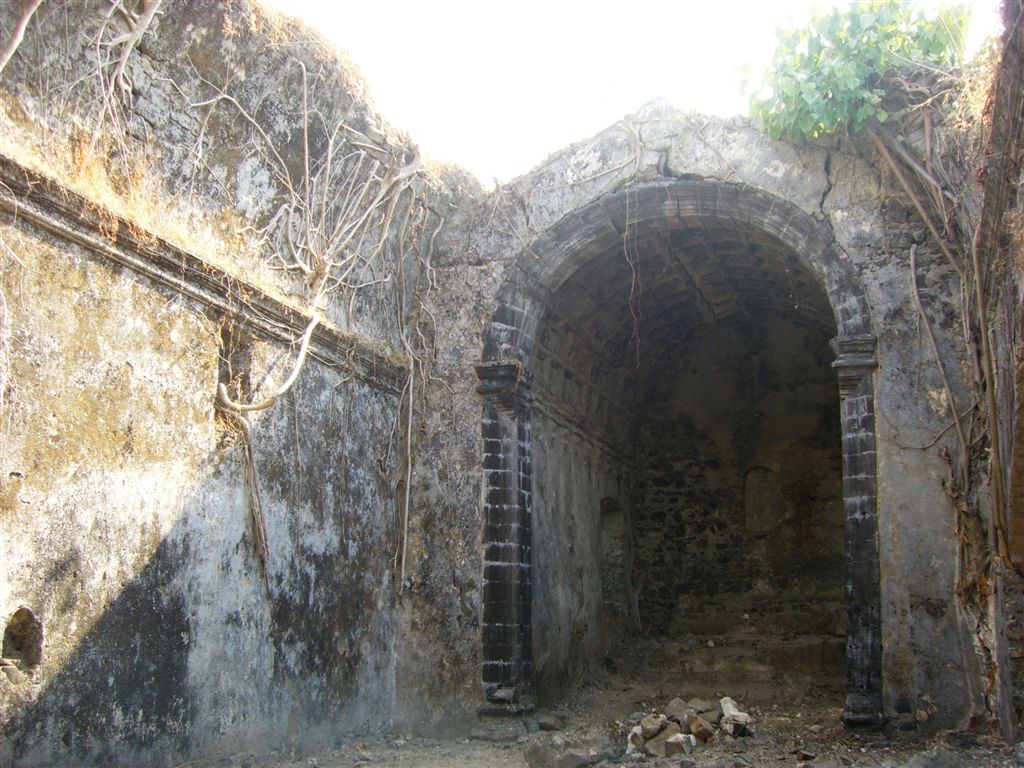
Korlai Fort is a colonial fort in the Raigad district of Maharashtra, India. Formerly a part of Chaul in Portuguese India, the structure is a specimen of Portuguese colonial architecture. It was built as a companion to the fort at Chaul, at this strategic position the Portuguese could use it to defend their province which stretched from Korlai to the Fort Bassein. Vestiges of the Portuguese occupation are manifested in the distinct dialect of the Korlai villages inhabitants which is a Luso-Indian creole called Korlai Portuguese Creole.
Korlai Fort is a colonial fort in the Raigad district of Maharashtra, India. Formerly a part of Chaul in Portuguese India, the structure is a specimen of Portuguese colonial architecture.
This fort was built in 1521 by the Portuguese with the permission of the Ahilyanagar sultanate. In 1521, taking advantage of the confusion in the aftermath of the death of the Burhan Nizam, the Portuguese tried to take over the fort. However the sultan retaliated and sent some of his best men to reclaim the fort. Subsequently, a truce was reached in which the Ahilyanagar sultanate occupied the island and no further fortification of the island took place. Only a wooden cross remained on the island as a sign of its former rulers. However, in 1594, Abranches, a Portuguese captain with 1,500 soldiers and 1,500 natives took possession of the fort. The besieged soldiers of the Sultanate tried to block their way by putting a dead elephant at the main gate and a dead horse at the inner gate. But in the end they had to surrender. The Portuguese won the fort but not having enough men to stand guard there chose to destroy it leaving only the central tower and a battery intact. Before its destruction, Korlai had been described by travelers as a "magnificent fortress as strong as any other in the world". On the inland side - the only place where it was susceptible to be attacked - it was protected by a ditch and could only be accessed by a drawbridge. The main entrance was guarded by a bronze lion and the highest tower by a bronze eagle. It housed 7,000 horses and as much men. Some parts of it were rebuilt later but now had a garrison of only 50 men. The church within the fort was used for worship on Sundays and holidays. Korlai fort was also strategically very important as it guarded the mouth of the bay. Chhatrapati Sambhaji Maharaj, the son of Chhatrapati Shivaji Maharaj, tried to take it over but failed and had to withdraw his forces on 6 December 1687. The fort was taken by the Marathas who held it from 1739 to 1818.
The last commandant of the fort, belong to Vanjari, who died a few years ago, must, like his predecessor, have wrought this nationalization of Portuguese names.”
The fort is 2,828 feet long, and its average breadth is eighty-nine feet. The enclosing wall is 5' 3" high and has 305 battlements for guns. It is entered by eleven gates - four are outer and seven are inner. At the north point, within pistol-shot of the main battery, is the water cistern named Santa Cruz, major source of water. The area within the fort walls is divided into three enclosures by two lines of bastioned fortifications. Each of the seven bastions bears the name of a saint.
The hill slopes surrounding the fort are in control of the Maharashtra Forest department. Originally trees of teak were planted on the eastern slopes. Later, in 1996, plantation of Casuarina, cashew and Acacia auriculiformis was done to check erosion.
GPS: 18.5358, 72.9081 · Open in Google Maps