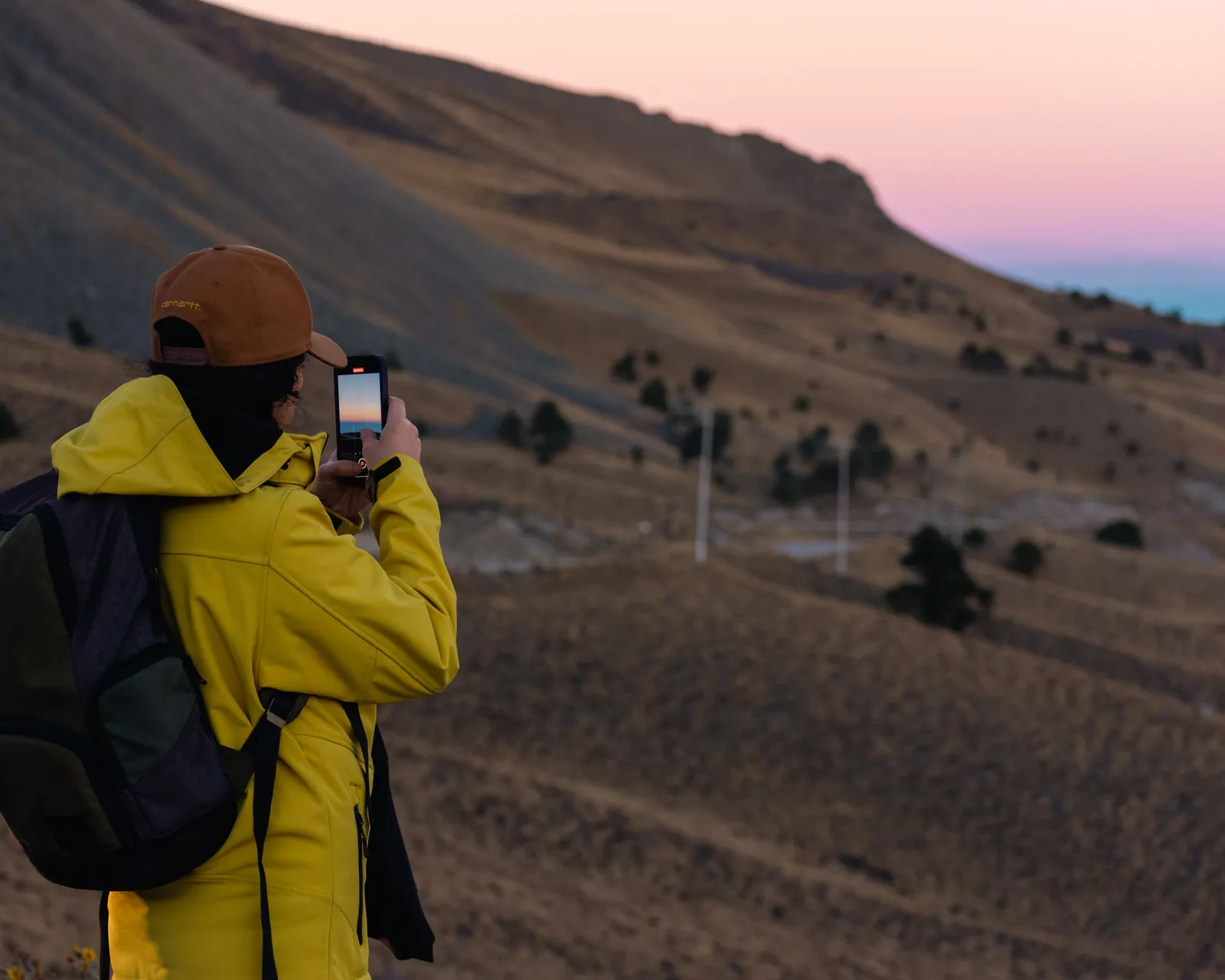
A dead phone on a trek is not just an inconvenience - it is your map, your torch, your camera and your emergency contact all going out at once. This guide covers how much power you actually need, why cold weather halves your battery, what to set up before you lose signal, and which electronics earn their weight on Indian trails.
Most trekkers either carry no power bank at all and run out on day two, or carry a 30,000 mAh brick for a weekend trek and haul half a kilo of unused capacity up a fort. Both are avoidable with five minutes of planning.
The other half of the problem is not capacity but consumption. A phone in a no-network zone burns battery searching for signal, and a cold phone reports itself dead while still holding charge. Fixing those two things saves more power than any upgrade.
Quick Recommendations by Trek Type
- Sahyadri day trek: no power bank. Airplane mode, a headlamp, and offline maps downloaded at home.
- Weekend trek, 2-3 days: one 10,000 mAh USB-C PD bank, around 200 g.
- Himalayan trek, 5-7 days: one 20,000 mAh USB-C PD bank, kept in your sleeping bag at night.
- Photography-heavy trip: 20,000 mAh bank for the phone plus three or four spare camera batteries.
- Group trek: one bank per person rather than one large shared bank. Redundancy matters more than total capacity.
Season Notes
In the monsoon, waterproofing is the real problem, not capacity - a dry bag for electronics matters more than an extra 10,000 mAh. On winter and high-altitude treks, plan for roughly a third less usable capacity than the rating suggests, keep everything in an inner pocket, and never charge a frozen power bank. In summer, the main risk is heat: do not leave a power bank in direct sun on the outside of your pack, which degrades the cells and can trigger thermal cutoffs.
How Much Capacity You Actually Need
Power banks lose roughly 30 to 35 percent of rated capacity to conversion. A 10,000 mAh bank delivers around 6,500 to 7,000 mAh in practice - plan with that number, not the one on the box.
- Sahyadri day trek: none needed. Start at 100 percent, use airplane mode, and you will finish the day above half.
- Weekend trek (2-3 days, no charging): 10,000 mAh. Around 1.5 to 2 full phone charges, at roughly 200 grams.
- Himalayan trek (5-7 days, no charging points): 20,000 mAh. Roughly 3 to 4 phone charges at 350-450 g, and the best weight-to-usefulness ratio available.
- Long expedition or a group sharing one bank: 20,000 mAh each is better than one 30,000 mAh shared - redundancy beats capacity, and a single failed bank should not strand the whole group.
- Photographers: budget one full bank for the phone and a separate set of spare camera batteries. Charging a mirrorless camera off a power bank is slow and wasteful.
- Add a margin for cold. Above 3,500 m in winter, assume you get about two-thirds of what you would at sea level.
What to Look For in a Trekking Power Bank
- Capacity per gram is the metric that matters. Good 20,000 mAh units land around 350-450 g; anything much heavier is old cell technology.
- USB-C Power Delivery (PD), ideally 20 W or more. It charges a phone in under an hour, which matters when you only get a short charging window at a teahouse.
- Pass-through charging is genuinely useful on multi-day trips - you can charge the bank and your phone from one socket overnight.
- Two output ports so you and a trek partner can charge simultaneously.
- A clear capacity rating printed on the body. Required for air travel, and unlabelled units get confiscated.
- Skip built-in torches, solar panels and wireless charging pads on power banks. All three add weight and none of them work well.
- Reliable brands available in India - Anker, Mi/Xiaomi, Ambrane, boAt, URBN and Realme - all make solid 10,000 and 20,000 mAh units in the 1,000 to 3,500 rupee range. There is no meaningful reason to spend more for trekking.
Cold Weather: Why Your Battery Dies at Altitude
Lithium-ion cells lose a large share of their usable capacity below about 5 degrees Celsius. A phone showing 60 percent at camp can shut down at 20 percent the moment you take it out in the wind - and the charge is not gone, just temporarily unavailable. Warm it against your body and it usually comes back.
The practical fixes are simple. Keep your phone and power bank in an inside jacket pocket rather than an outer one or the top of your pack. At night, put both inside your sleeping bag; the difference between a bank kept in a cold tent vestibule and one kept in the bag is substantial.
Do not charge a power bank that is very cold - charging lithium cells below freezing damages them permanently. Warm it in your jacket for fifteen minutes first.
Making Your Phone Last (Free, Works Better Than Buying)
- Airplane mode with GPS enabled. This is the single biggest saving on any trek - a phone hunting for a signal in a dead zone can drain from full to empty in half a day.
- Download offline maps before you leave signal. Google Maps offline areas work, but a dedicated app is better on trails.
- Screen brightness down, auto-brightness off. On a bright trail your phone drives the screen to maximum and it is the second biggest drain after the radio.
- Turn off background app refresh and location for everything except your maps app.
- Low-power mode from the start of the day, not once you are at 20 percent.
- Do not use your phone as your primary torch. A headlamp is brighter, hands-free, runs on cheap AAA cells, and does not cost you your map and your emergency contact.
Offline Maps and Navigation
- AllTrails, Gaia GPS and Maps.me all support downloadable offline trail maps and work fine without signal. Download the region at home over WiFi.
- OpenStreetMap-based apps such as OsmAnd and Organic Maps have surprisingly good coverage of Sahyadri fort trails, much of it mapped by local trekkers.
- Drop your trailhead, parking spot and campsite as offline pins before you start. Finding a car in the dark at a Sahyadri base village is a real problem.
- Screenshot the route description and any group instructions. Screenshots work with a dead network; web pages do not.
- GPS itself works without a mobile network - the phone only needs the map data cached, which is exactly what offline downloads provide.
- Carry the trek leader's number written on paper. A phone that dies takes every contact you have with it.
The Rest of the Electronics Packing List
- Headlamp with spare batteries - non-negotiable on any trek that might run past sunset, and far more useful than a phone torch.
- Short, tough charging cables. Long thin cables fray in a pack and fail at the worst moment. Carry one spare; it weighs nothing.
- A small dry bag or zip-lock for electronics. In the monsoon Sahyadris this is not optional - it rains sideways and packs are never fully waterproof.
- Spare camera batteries rather than charging a camera from a bank. Cold drains them fast, so carry two more than you think you need and keep them in an inner pocket.
- A basic watch with an alarm, so you are not relying on the phone for pre-dawn starts.
- Optional but useful on remote Himalayan trails: a satellite messenger. Overkill for Sahyadri weekend treks, genuinely life-saving on high, unsupported routes.
- Leave behind: laptops, tablets, drones without permits, and Bluetooth speakers. The last one especially - it is the fastest way to ruin a campsite for everyone else.
Flying With Power Banks
- Cabin baggage only. Power banks and spare lithium batteries are prohibited in checked luggage on every Indian airline.
- Up to 100 Wh (roughly 27,000 mAh at 3.7 V) is generally allowed without prior approval. 100-160 Wh needs airline permission. Above 160 Wh is not permitted.
- The capacity must be printed and legible on the unit. Security routinely confiscates unmarked power banks, and there is no appeal at the counter.
- Two power banks per passenger is the usual limit; carry them in your cabin bag rather than loose in your pockets.
- Tape or cap exposed terminals on spare camera batteries and carry them in their cases.
- Rules change and enforcement varies by airport. Check your airline's current dangerous-goods page before a trek that starts with a flight.
Safety and Reliability Notes
- Never treat a phone as your only light source or your only navigation. Carry a headlamp and a written or screenshotted route.
- Do not buy unbranded power banks from marketplace sellers with no capacity marking - poor cell quality and absent protection circuitry are a genuine fire risk in a packed rucksack.
- A swollen power bank or phone battery gets retired immediately. Do not carry it up a mountain.
- Keep the trek leader's number and one emergency contact written on paper in your pack.
- Charge everything to full the night before, including the power bank. People forget the bank itself.
- Do not rely on the last of your battery for a summit selfie if you still need navigation for the descent. Descents in fading light are where most trail accidents happen.
Frequently Asked Questions
Keep Reading
More trekking gear guides:
Final Thoughts
For most Indian treks the right answer is boring: one 10,000 or 20,000 mAh USB-C power bank, airplane mode from the trailhead, offline maps downloaded at home, and a proper headlamp so the phone is never doing a torch's job.
Everything past that - solar panels, satellite messengers, camera charging rigs - is for specific trips with specific needs. Buy those when the trek demands them, not before.
- 10,000 mAh for a weekend, 20,000 mAh for a Himalayan week.
- Airplane mode with GPS on, from the trailhead.
- Offline maps and screenshots downloaded before you lose signal.
- Electronics in an inside pocket in the cold, in a dry bag in the rain.