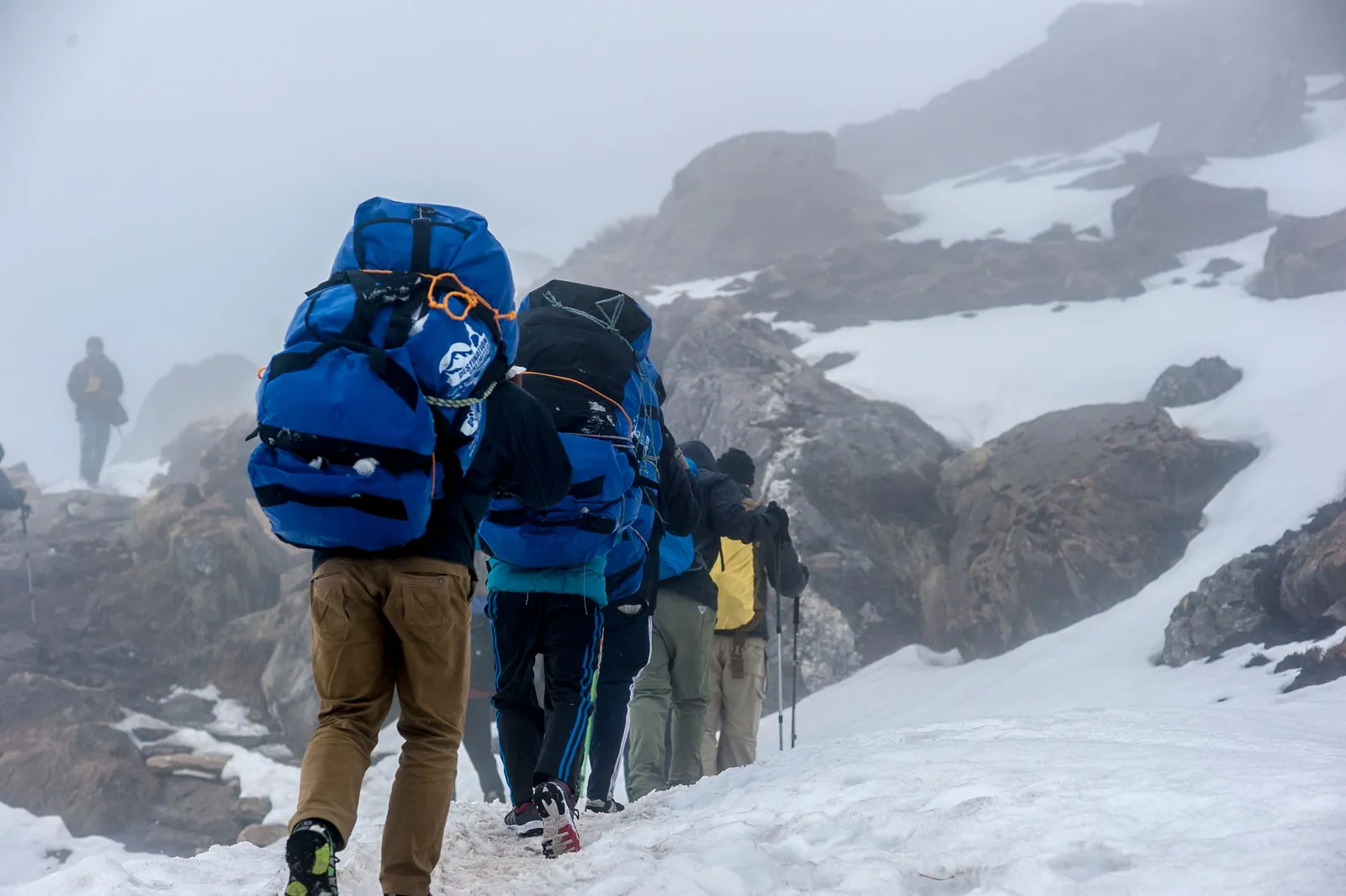
December and January split India's trekking map neatly into two very different experiences. Up in the Himalayas, this is peak snow-trek season — frozen lakes, powder-covered ridgelines, and campsites well below freezing. Down in the Sahyadris and Western Ghats, this same window is arguably the single best time of year to trek, with the monsoon long gone and clear, cool weather all along the trail. Here's how to pick between them, and the specific treks worth doing in each.
Himalayan Snow Treks: December-January
Winter in the Himalayas transforms familiar trails into something else entirely — forests dusted white, ridgelines under fresh powder, and campsites that demand real cold-weather preparation. These are the standout snow treks for this window.
1. Kedarkantha, Uttarakhand
Kedarkantha is the trek most people picture when they think 'Himalayan winter trek', and for good reason. Starting from Sankri, it climbs gently through snow-laden pine forest before opening into wide white meadows, with a short, steep summit push rewarding you with views of the Swargarohini and Bandarpoonch massifs.
December through February is peak season here, with fresh snowfall making the trail genuinely striking — and it's popular enough that the trail stays well-packed even after heavy snow, which matters for a winter first-timer.
- Altitude: 3,800 m
- Duration: 5-6 days
- Best months: December-February
- Base camp: Sankri
2. Dayara Bugyal, Uttarakhand
Dayara Bugyal near Uttarkashi swaps Kedarkantha's crowds for a gentler, more solitary version of the same winter experience. Its trademark high-altitude meadow, carpeted in wildflowers in summer, turns into a vast, rolling expanse of snow in December and January, with minimal steep climbing involved.
Because the gradient is so gentle throughout, it's often recommended for families or trekkers easing into winter trekking, without sacrificing the visual payoff of deep, open snowfields against the Bandarpoonch range.
- Altitude: 3,024 m
- Duration: 4-5 days
- Best months: December-February
- Base camp: Uttarkashi
3. Chadar Trek, Ladakh
The Chadar Trek is in a category of its own — it doesn't climb a mountain at all, but instead follows the frozen Zanskar river through a dramatic gorge, walking on the ice sheet ('chadar') that forms only in the depths of winter. It runs exclusively in January and February, when the river freezes solid enough to support the trail.
This is a significantly higher-difficulty, higher-risk trek than the others on this list, involving extreme cold, camping directly on or beside the ice, and specific technical guidance from experienced local operators. It's not a beginner trek, but for experienced winter trekkers it's one of the most unusual landscapes India's mountains offer.
- Altitude: ~3,400-3,800 m along the river
- Duration: 7-9 days
- Best months: January-February only
- Difficulty: High — prior trekking experience recommended
Non-Snow Winter Treks: Sahyadris & Western Ghats
Winter isn't just a Himalayan season — for the Sahyadris and Western Ghats, November through February is actually the best window of the year to trek, and December-January sits right in the middle of it.
4. Kalsubai, Maharashtra
Kalsubai, the highest peak in Maharashtra, is a busy weekend trek year-round, but winter is when it's most enjoyable to actually climb — the monsoon's slippery rock sections and leeches are gone, replaced by firm dry trail and some of the clearest visibility of the year from the summit.
Cool morning temperatures make the climb far more comfortable than the heat of summer, and on a clear winter day the summit view stretches impressively far across the Sahyadri range.
- Altitude: 1,646 m — highest peak in Maharashtra
- Duration: Day trek
- Best months: November-February
- Base: Bari village
5. Harishchandragad, Maharashtra
Harishchandragad is a favourite among Sahyadri regulars for its combination of history and scenery — ancient temple ruins, the Konkan Kada cliff edge, and the Kedareshwar cave temple, all easier to explore safely in winter's dry conditions than during the monsoon when rock sections turn treacherous.
Winter mornings here can get genuinely cold at the summit plateau, especially if you camp overnight, which adds a different character to what's usually thought of as a fair-weather trek.
- Altitude: 1,424 m
- Duration: Overnight trek (popular) or long day trek
- Best months: November-February
- Highlight: Konkan Kada, Kedareshwar cave
6. Rajmachi, Maharashtra
Rajmachi, near Lonavala, is one of the most accessible weekend treks from Mumbai and Pune, and winter is when its twin forts — Shrivardhan and Manaranjan — and surrounding valley views are at their sharpest, with none of the monsoon haze that softens the same view in July.
It's a gentler, shorter trek than Kalsubai or Harishchandragad, which makes it a good pick for a relaxed winter weekend that still delivers real Sahyadri scenery.
- Altitude: ~1,375 m
- Duration: Day trek or overnight camping
- Best months: November-February
- Base: Lonavala
7. Deoriatal-Chandrashila, Uttarakhand
Deoriatal-Chandrashila combines two of the Himalayas' most photogenic features into one winter trek — Deoriatal, a small alpine lake known for reflecting the Chaukhamba massif on a still morning, and Chandrashila, a summit ridge that in December-January is usually under a fresh layer of snow with uninterrupted views across several major peaks.
It's graded easy-to-moderate and starts from Sari village near Ukhimath, making it a good option for trekkers who want genuine winter snow and a lake-plus-summit combination without the crowds of Kedarkantha.
- Altitude: 3,995 m (Chandrashila summit)
- Duration: 4-5 days
- Best months: December-February
- Base: Sari village, near Ukhimath
8. Torna Fort, Maharashtra
Torna, the tallest fort in the Pune district and the first fort Chhatrapati Shivaji Maharaj captured, is a demanding but rewarding winter trek for Sahyadri regulars who want something more strenuous than Rajmachi or Kalsubai. Its steep approach and exposed sections are far more manageable in winter's dry, cool conditions than in the monsoon, when the same climb becomes genuinely risky.
Winter mornings at Torna's summit plateau, dotted with fort ruins and old water cisterns, offer some of the clearest long-range Sahyadri views of the year, extending toward neighbouring forts like Rajgad on a good day.
- Altitude: 1,403 m
- Duration: Day trek (strenuous)
- Best months: November-February
- Base: Velhe village
Winter Trekking Gear Checklist
Gear needs differ sharply between a Himalayan snow trek and a Sahyadri winter day trek, and packing for the wrong one is a common first-timer mistake.
- Himalayan snow trek: waterproof insulated trekking shoes, gaiters, micro-spikes/crampons, sub-zero-rated sleeping bag, thermal base layers, down jacket, woolen cap and gloves
- Himalayan snow trek: sunglasses/goggles for snow glare, sunscreen (UV reflects off snow), trekking poles for stability on packed snow
- Sahyadri winter trek: one warm layer for cold mornings/evenings, comfortable trekking shoes, a headlamp if camping overnight, sufficient water (winter reduces thirst cues but not actual hydration needs)
- Both: a basic first-aid kit and a fully charged phone/power bank, since winter daylight hours are shorter than other seasons
What Weather to Expect in December-January
December and January bring the coldest, driest weather of the year to most of India's trekking regions, but the specifics vary sharply by altitude and location. In the Himalayan foothills and mid-altitude treks (2,500-3,000 m), daytime temperatures on clear days can feel pleasant in direct sun, even as nighttime temperatures at the same campsite drop well below freezing — the swing between day and night is often the single most underestimated factor for first-time winter trekkers.
Snowfall patterns also shift through the season: early December often has thinner, patchier snow cover on routes like Kedarkantha, building to deeper, more consistent snow by late December through January as successive winter spells pass through. Trekkers chasing the deepest snow cover generally do better booking for late December or January rather than the very start of the season, though this also means colder nights and more demanding trail conditions underfoot.
In the Sahyadris and Western Ghats, December-January weather is far more predictable and forgiving — clear skies, low humidity, and daytime temperatures that rarely drop uncomfortably even at higher points like Kalsubai's summit. Morning fog is common in valley areas and burns off by mid-morning, and it's this combination of dry trails, good visibility, and comfortable temperatures that makes the region's winter season so consistently recommended over its monsoon or summer alternatives.
Booking, Crowds, and Practical Timing
December-January is peak season for both categories of trek, which has direct practical consequences. Kedarkantha and Brahmatal batches fill up well in advance around Christmas and New Year specifically, when Indian trekkers commonly plan multi-day trips around the holiday break — booking at least a few weeks ahead for these dates is a reasonable precaution rather than an overcautious one. Weekday batches through December and January are noticeably less crowded and often easier to book on shorter notice.
Sahyadri weekend treks face a similar but smaller version of this crowding on Saturdays and Sundays specifically, while weekday visits to Kalsubai, Harishchandragad, or Rajmachi in the same season are considerably quieter. If solitude matters more to you than convenience, shifting either category of trek to a weekday, or choosing a slightly less famous route within the same region (Dayara Bugyal over Kedarkantha, Torna over Kalsubai), consistently delivers a calmer experience without sacrificing the season's core advantages.
Winter-Specific Health and Safety Notes
Winter trekking introduces risks that don't apply, or apply far less, in other seasons, and it's worth being specific about them rather than treating 'winter trek' as just a colder version of a normal trek. Frostbite and cold-related injuries are a real concern on Himalayan snow treks if extremities aren't properly insulated — quality gloves, warm socks, and covering exposed skin during extended cold exposure matter more here than on a monsoon or summer trek. Snow blindness, caused by UV reflecting off snow, is another winter-specific risk, which is why sunglasses rated for snow conditions (not just regular sunglasses) are commonly included in organised trek gear lists.
Shorter winter daylight hours also change trip planning in a practical way — with sunset often by 5:30-6 pm in December-January, itineraries need to account for less usable daylight per day than a monsoon or autumn trek would have, which is part of why organised treks build earlier start times and slightly shorter daily distances into winter itineraries. For Sahyadri winter treks, the main additional consideration is simply carrying a warm layer for the genuinely cold early mornings and evenings, even though daytime temperatures feel comfortable — a mistake many first-timers make is packing only for the pleasant midday weather and being caught off guard at a pre-dawn start or a late descent.
Why This Specific Window Works So Well
December and January sit at the heart of both regions' respective best seasons rather than at the edges, which is exactly why the window is worth planning around deliberately. In the Himalayas, this period follows enough consistent winter storm activity that snow cover is well-established (unlike early November, when snow can still be patchy), while staying well before the pre-monsoon warming that starts softening trail conditions from March onward.
In the Sahyadris and Western Ghats, this window falls squarely in the post-monsoon recovery period — long enough after the rains that trails have dried out and water crossings have settled, but before the pre-summer heat (from March onward) makes daytime trekking uncomfortable. Choosing December-January specifically, rather than just 'winter' more broadly, means arriving at close to the optimal combination of conditions for whichever category of trek you choose.
Frequently Asked Questions
Find Your Winter Trek
From Himalayan snow treks to Sahyadri weekend classics, find upcoming winter batches and connect with trek leaders on TrekVerse.
Explore TreksHow to Choose Between a Snow Trek and a Sahyadri Trek
Plan Your Winter Trek
Continue exploring winter and destination guides: