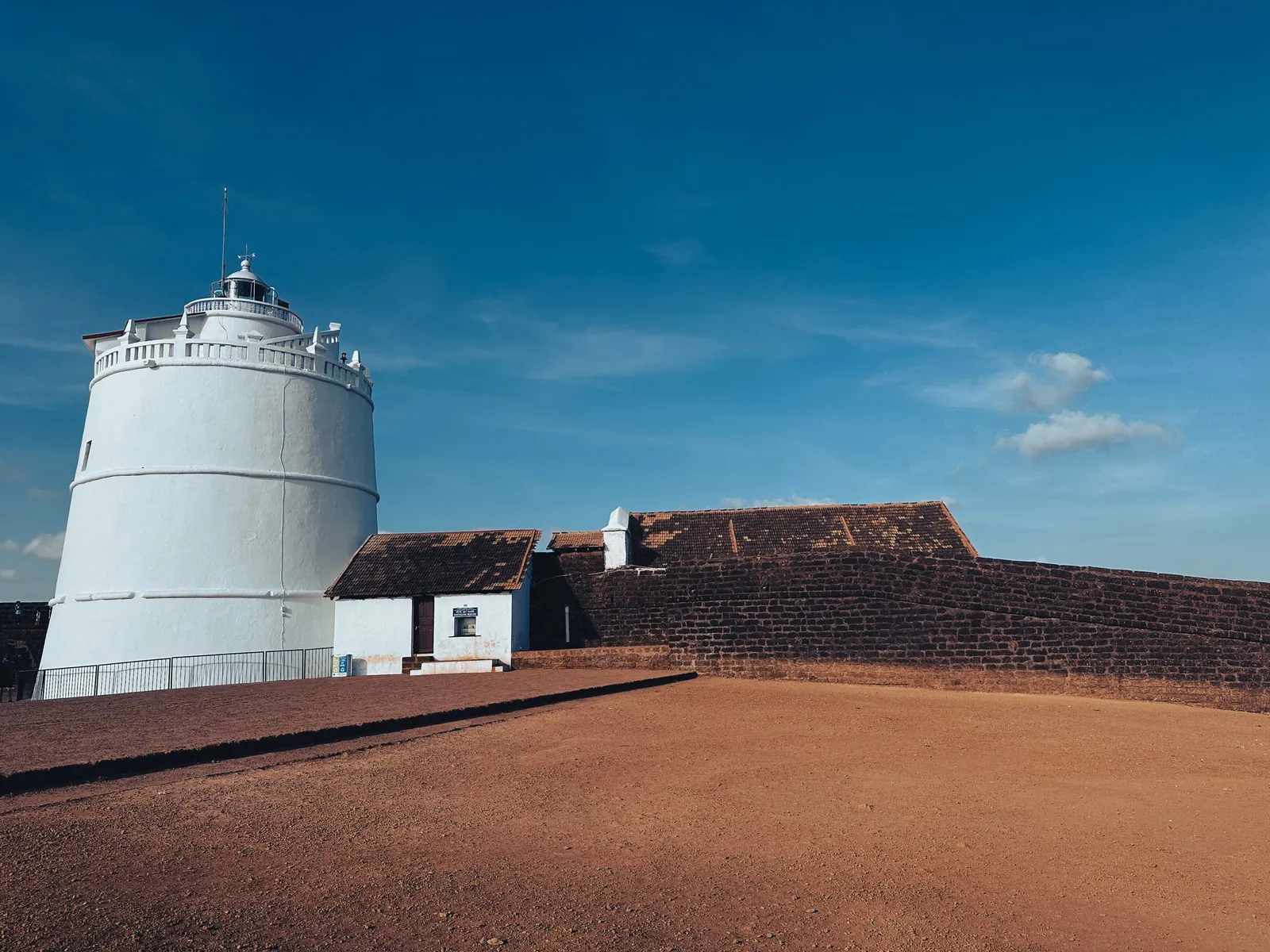
Goa's beaches get all the attention, but the state's coastline and river mouths are lined with Portuguese-era forts that tell a very different story — nearly 450 years of colonial rule, trade routes, and coastal defence. Spend a day fort-hopping instead of beach-hopping and you get a version of Goa that most visitors never see. Here's how to do it.
1. Fort Aguada
Fort Aguada, on the headland at Sinquerim near Candolim, is Goa's best-preserved fort and the natural starting point for any fort-hopping trip. Built in 1612 to guard the mouth of the Mandovi river against Dutch and Maratha raids, it also housed a freshwater spring that gave passing ships (and the fort) its name — 'aguada' means 'watering place' in Portuguese.
The fort's four-storey lighthouse, one of the oldest of its kind in Asia, still stands, and the lower fort near the water once served as a prison (parts of it functioned as a jail until fairly recently). The upper fort's bastions and moat are largely intact, and the sea views from the ramparts alone justify the visit.
- Location: Sinquerim, near Candolim
- Built: 1612
- Best for: Best-preserved fort, working lighthouse, sea views
- Time needed: 1-1.5 hours
2. Chapora Fort
Chapora Fort, perched on a headland above Vagator, is Goa's most photographed fort — largely thanks to its cameo in the film Dil Chahta Hai, which still draws a steady stream of visitors climbing up for sunset. Structurally there isn't much left beyond the outer laterite walls; the interior structures have long since crumbled.
What remains is still worth the short, easy climb: 360-degree views over the Chapora river mouth, Vagator's cliffs, and the Arabian Sea. It was originally built by the Adil Shahi rulers of Bijapur before the Portuguese took it over in the 17th century, making it one of the few forts on this list with a pre-Portuguese layer of history.
- Location: Above Vagator beach
- Built: Adil Shahi era, taken over by Portuguese in 1617
- Best for: Sunset views, easy short climb
- Time needed: 45 minutes-1 hour
3. Reis Magos Fort
Reis Magos sits directly across the Mandovi river from Fort Aguada, and the two forts were built to work together, guarding the river mouth from opposite banks. Unlike most entries on this list, Reis Magos has been fully restored — a multi-year conservation project reopened it as a heritage centre with art galleries and exhibits on Goa's history.
The restoration makes it the most polished visit of the North Goa forts, with clean ramparts, a small museum, and views straight across the river to Aguada. Its adjoining Reis Magos Church, one of the oldest in Goa, is worth the extra few minutes.
- Location: Reis Magos village, near Panaji
- Built: 1551, restored 2008-2012
- Best for: Fully restored fort, art galleries, river views
- Time needed: 1-1.5 hours
4. Cabo de Rama
Cabo de Rama, in South Goa near Canacona, is the fort most travellers skip simply because it's further from the North Goa cluster — and that's exactly why it's worth the detour. Set on a dramatic cliff above the Arabian Sea, the site predates the Portuguese entirely; local legend holds that Lord Rama and Sita sheltered here during their exile, giving the headland its name.
The fort itself was fortified further by the Portuguese in the 18th century and later used as a prison. Much of it is in ruins today, but the cliffside setting, with the sea dropping away on three sides, makes it one of the most scenic fort visits in Goa, especially at sunset with far fewer crowds than Chapora.
- Location: Near Canacona, South Goa
- Best for: Cliffside views, fewer crowds, pre-Portuguese legend
- Time needed: 1 hour
5. Corjuem Fort
Corjuem Fort is a small, square island fort in North Goa's interior, reached by a short bridge over the Mapusa river near Aldona — a setting that feels far removed from the coastal forts on this list. Built in 1705, it was primarily used to guard river trade routes rather than the coastline itself.
It's modest in scale compared to Aguada or Chapora, but its inland, riverine setting and near-total absence of tourist crowds make it a quiet, offbeat stop for anyone wanting to see a side of Goa that has nothing to do with beaches.
- Location: Aldona, North Goa (inland)
- Built: 1705
- Best for: Offbeat, riverine setting, quiet visit
- Time needed: 30-45 minutes
6. Tiracol Fort
Tiracol Fort sits at the very northern tip of Goa, on the far bank of the Tiracol river where it meets the sea, right on the border with Maharashtra. Reaching it involves a short, scenic ferry crossing, which alone makes it feel like a proper excursion rather than a quick stop.
Part of the fort has been converted into a heritage hotel, but its chapel — dedicated to St Anthony — and the outer ramparts remain open to visitors, and the views across the river mouth toward Querim beach are some of the best on this list.
- Location: Tiracol, northern tip of Goa (Maharashtra border)
- Best for: Ferry crossing, river-mouth views, heritage hotel setting
- Time needed: 1 hour, plus ferry time
7. Mormugao Fort
Mormugao Fort, near Vasco da Gama, guarded one of the most strategically important harbours on the west coast — Mormugao remains a major Indian port to this day. Built in the late 16th century, the fort has been largely absorbed into the modern port and naval area, so what survives is fragmentary compared to the other forts here.
It's the least visited fort on this list precisely because of that, but for anyone interested in the full arc of Goa's coastal defence system — not just the postcard-ready ruins — it completes the picture of how the Portuguese controlled this coastline for nearly four and a half centuries.
- Location: Near Vasco da Gama
- Built: Late 16th century
- Best for: Completing the coastal-defence picture, least crowded
- Time needed: 30-45 minutes
Goa Beyond the Beaches: Why the Forts Matter
Goa spent nearly 450 years under Portuguese rule — from 1510 until its annexation by India in 1961 — longer than any other European colonial holding on the subcontinent. That timeline is exactly why its coastline is so densely fortified compared to the rest of India: every river mouth and headland that could shelter a rival navy or smuggle in an attacking force needed a garrison watching it, and the Portuguese built accordingly, layering forts along the Mandovi, Zuari, Chapora, and Tiracol rivers as much as along the open coast.
That density is also why fort-hopping works so well as a single organising theme for a Goa trip that isn't about beaches at all. Where a Rajasthan fort tour moves between distant cities, Goa's forts are close enough together, and different enough in condition — from Reis Magos' full restoration to Mormugao's near-total absorption into a working port — that a single day or two gives a genuinely rounded picture of colonial-era coastal defence, something most visitors never plan for.
Planning Your Fort-Hopping Day (or Two)
North Goa's three forts — Aguada, Chapora, and Reis Magos — sit within about 20-25 km of each other and can comfortably be covered in a single day by scooter or car, starting at Aguada in the morning, crossing to Reis Magos by midday, and finishing at Chapora for sunset. Cabo de Rama, Corjuem, Tiracol, and Mormugao are more scattered and work better as a second, more relaxed day if you want to see all seven.
- Best time to visit: October to March, early morning or late afternoon to avoid the midday heat
- Getting around: A rented scooter is the easiest way to fort-hop in Goa; most forts have parking nearby
- Entry: Most forts (Chapora, Cabo de Rama, Corjuem) are free; Reis Magos charges a small fee for its galleries
- Footwear: Ramparts and approach paths are uneven laterite stone — wear grippy shoes, not flip-flops
- Combine with: A short hike or two if you enjoy independent exploring — several forts have coastal trail approaches
A Sample Two-Day Fort-Hopping Itinerary
- Day 1 morning: Fort Aguada — lighthouse, bastions, sea views over Sinquerim
- Day 1 midday: Reis Magos Fort — restored galleries, church, views across to Aguada
- Day 1 evening: Chapora Fort — sunset from the headland above Vagator
- Day 2 morning: Corjuem Fort — quiet, inland, riverine setting near Aldona
- Day 2 midday: Tiracol Fort — short ferry crossing, chapel, river-mouth views
- Day 2 afternoon: Cabo de Rama or Mormugao, depending on which coast (south or Vasco) you're closer to
What to Pair With Your Fort Visits
Each fort cluster sits near villages and beaches worth combining with the visit rather than treating the fort as an isolated stop. Aguada and Chapora both sit within walking or short-scooter distance of well-known beaches (Sinquerim, Candolim, and Vagator), so an early fort visit followed by a relaxed beach afternoon is an easy way to blend the two sides of a Goa trip. Reis Magos and Corjuem, being river-facing rather than beach-facing, pair better with Goa's Portuguese-era churches and heritage villages — Old Goa's basilicas, in particular, are a natural extension of the same colonial history the forts represent.
Tiracol, given the ferry crossing and its northern location, works best as a half-day excursion combined with Querim or Arambol beach rather than squeezed into the North Goa fort circuit. And Cabo de Rama in the south pairs naturally with Goa's quieter southern beaches like Agonda and Palolem, offering a slower, less crowded version of a Goa day out.
What Makes Portuguese Forts in Goa Different
Goa's forts look and feel distinct from the Rajput hill forts elsewhere in India, and that difference comes down to who built them and why. Portuguese military engineers designed these forts primarily around naval defence — guarding river mouths and harbour approaches against rival European fleets (Dutch and later British) rather than against land-based sieges, which explains why so many sit low, right at the water's edge, rather than on defensible hilltops the way Rajasthan's forts do.
Construction material also sets them apart. Most Goan forts use local laterite stone, a porous reddish rock that erodes distinctively over time, giving ruins like Chapora their crumbling, weathered look compared to the more intact sandstone and marble structures of North India. That same laterite, incidentally, is still used in traditional Goan house construction today, so the forts and the older village houses around them share a visible material connection that's easy to miss unless you're looking for it.
Religious architecture nearly always accompanies these forts too — a chapel dedicated to a Catholic saint sits within or immediately next to almost every fort on this list, a reminder that Portuguese colonial expansion in Goa was as much about religious conversion as military and trade control. Reis Magos, Tiracol, and Cabo de Rama all retain functioning or restored chapels, which is worth factoring into your visit if you're interested in the fuller colonial-era picture rather than just the ramparts.
Practical Tips for a Goa Heritage Trip
A fort-hopping trip needs slightly different planning than a beach holiday, mostly around timing, transport, and what to carry.
- Rent a scooter rather than relying on taxis — Goa's forts are spread along back roads that taxis rarely serve efficiently
- Carry cash for smaller entry fees and local eateries near the forts, especially Corjuem and Tiracol where digital payment options are limited
- Start early in the day for Aguada and Chapora — both get genuinely crowded by late morning during peak season (December-February)
- Check ferry timings for Tiracol in advance — services can be infrequent outside peak tourist months
- Carry sun protection even in the cooler months — Goa's coastal sun is strong year-round, and fort ramparts offer little shade
- Combine with monsoon caution — several forts (Cabo de Rama, Chapora) have unguarded cliff edges that become genuinely hazardous in wet weather
Best Time of Year for a Goa Fort Trip
October through March is comfortably the best window for fort-hopping in Goa, coinciding with the dry, tourist-season weather most visitors already associate with the state. Within that window, December and January bring the coolest, most comfortable daytime temperatures for walking around exposed ramparts, though also the largest crowds at the better-known forts.
The monsoon months (June-September), while generally avoided for beach holidays, actually offer a distinctive version of fort-hopping worth considering if you don't mind getting wet — lush greenery around Corjuem and Tiracol, dramatic storm-lit skies over Chapora and Cabo de Rama, and near-total absence of other visitors. The trade-off is real: slippery laterite stone, reduced visibility on cliffside forts, and the genuine hazard of unguarded edges in wet conditions, so monsoon visits call for extra caution and sturdy, grippy footwear.
Frequently Asked Questions
Plan Your Goa Heritage Trip
Discover more offbeat itineraries and connect with fellow travellers planning trips across India on TrekVerse.
Explore TreksMore Heritage & Destination Guides
Keep exploring India's forts and coastal heritage: