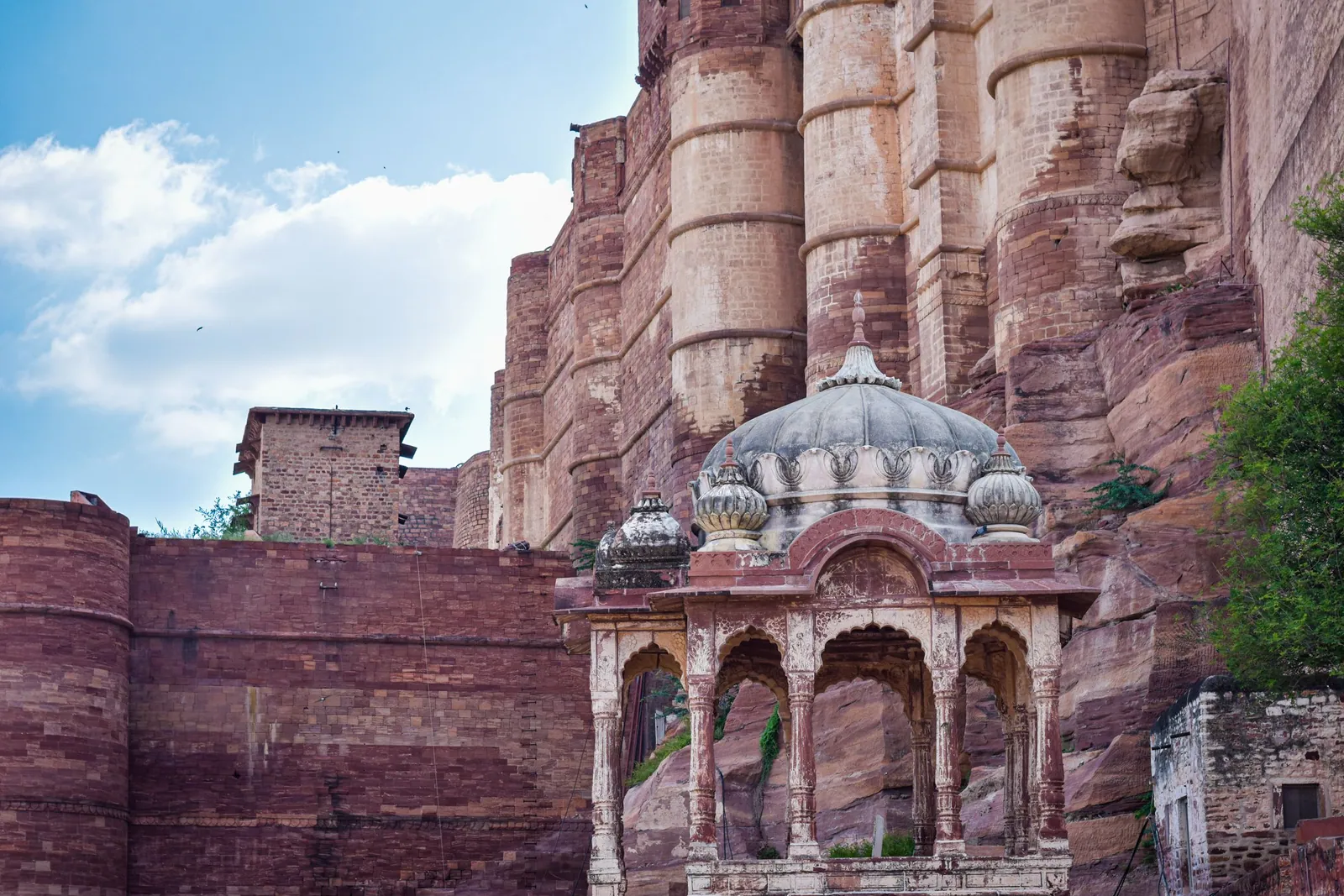
Rajasthan doesn't do subtlety when it comes to forts. Every major city here grew up around a hilltop citadel, and centuries later those same forts remain the single best reason to plan a weekend trip to the state — not as a single monument to tick off, but as a string of genuinely different experiences in stone. Here are the Rajasthan forts most worth building a weekend around, why each one earns its reputation, and how to actually plan the trip.
1. Mehrangarh Fort, Jodhpur
Mehrangarh sits on a sheer 125-metre rock outcrop above Jodhpur, and it's the fort most first-time visitors to Rajasthan come away calling their favourite. Founded in 1459 by Rao Jodha, it has survived largely intact, and its museum — spread across several ornately carved palace wings — is consistently rated among the best-curated in India, with an audio guide that actually adds context rather than reciting dates.
What sets Mehrangarh apart is the view it gives back: the ramparts look straight down over Jodhpur's famous blue-washed old city, a genuinely striking sight at sunset. The fort walls themselves still bear cannonball scars from historical sieges, a small detail that makes the place feel lived-in rather than merely preserved.
- Location: Jodhpur
- Built: 1459 CE by Rao Jodha
- Best for: Museum, ramparts, Blue City views
- Time needed: 2.5-3 hours
- Best time to visit: Early morning or just before sunset
2. Amber Fort (Amer Fort), Jaipur
Amber Fort, about 11 km from central Jaipur, is where most people's mental image of a 'Rajasthan fort' actually comes from — honey-coloured sandstone and marble, a hilltop setting above Maota Lake, and the Sheesh Mahal (Mirror Palace) whose thousands of tiny mirror fragments still catch a single candle flame and scatter it across the ceiling.
Amber is one of the six forts inscribed together as the UNESCO 'Hill Forts of Rajasthan', and unlike some of the more remote entries on this list, it's the easiest to fold into a genuine weekend trip since Jaipur airport puts it within an hour of most Indian cities.
- Location: Amer, 11 km from Jaipur
- UNESCO status: Yes (Hill Forts of Rajasthan)
- Best for: Sheesh Mahal, Jaipur's most photographed fort
- Time needed: 2-3 hours
- Tip: Arrive at opening time to beat the crowds
3. Chittorgarh Fort
Chittorgarh is widely regarded as the largest fort in India, a roughly 700-acre hilltop complex with a perimeter of about 13 km that once housed an entire city, not just a garrison. Its history is the most dramatic on this list — the fort was besieged three times between the 13th and 16th centuries, and each siege is remembered in Rajasthani lore for acts of resistance and sacrifice.
Inside, the Vijay Stambh (Tower of Victory) and the older Kirti Stambh (Tower of Fame) are the two structures most visitors photograph, but the fort rewards slower exploration — Rana Kumbha's palace, the Padmini Palace, and several temples are spread across a site large enough that a rushed half-day visit barely scratches it.
- Location: Chittorgarh city
- Size: ~700 acres, ~13 km perimeter — India's largest fort
- UNESCO status: Yes (Hill Forts of Rajasthan)
- Best for: History, Vijay Stambh, scale
- Time needed: 3-4 hours minimum
4. Jaisalmer Fort
Jaisalmer Fort, nicknamed Sonar Quila (Golden Fort) for the way its yellow sandstone glows at sunset, is one of the few 'living forts' left in the world — roughly a quarter of Jaisalmer's old city population still lives within its walls, running havelis-turned-guesthouses, shops, and temples inside the ramparts.
That living quality is exactly what makes it different from every other fort on this list: you're not touring a museum, you're walking through an active neighbourhood built centuries ago, complete with narrow lanes, Jain temples with extraordinary carved marble interiors, and rooftop cafés with fort-wall views over the Thar Desert.
- Location: Jaisalmer, western Rajasthan
- UNESCO status: Yes (Hill Forts of Rajasthan)
- Best for: 'Living fort' experience, Jain temples, desert views
- Time needed: Half a day (it's a walkable old town)
- Note: Best combined with a Thar Desert stay given the distance
5. Kumbhalgarh Fort
Kumbhalgarh, built in the 15th century by Rana Kumbha, is best known for one fact that tends to surprise people: its perimeter wall runs roughly 36 km, making it the second-longest continuous wall in the world after the Great Wall of China. It snakes over hills and valleys, following the natural terrain rather than a straight line.
The fort itself sits within a wildlife sanctuary in the Aravalli hills and was reputedly never breached by direct assault, which locals attribute partly to the wall's scale and partly to the fort's water-scarce, easily defensible perch. It's quieter than Amber or Mehrangarh, which makes it a good pick if you want a fort without the crowds.
- Location: Rajsamand district, ~85 km from Udaipur
- UNESCO status: Yes (Hill Forts of Rajasthan)
- Best for: The great wall, wildlife sanctuary setting, fewer crowds
- Time needed: 2-3 hours
- Highlight: Light and sound show in the evening
6. Ranthambore Fort
Ranthambore Fort is unusual on this list because most visitors reach it as a side trip from a tiger safari rather than the other way around — the fort sits inside Ranthambore National Park, and its ancient temples and ramparts are often glimpsed from a jeep before anyone actually walks them.
That said, the fort deserves its own visit: it dates back to the 10th century, changed hands numerous times between Rajput rulers, the Delhi Sultanate, and the Mughals, and its Ganesh temple remains an active pilgrimage site. Combining a fort walk with a tiger safari makes Ranthambore one of the more distinctive weekend-trip combinations in Rajasthan.
- Location: Inside Ranthambore National Park, Sawai Madhopur
- UNESCO status: Yes (Hill Forts of Rajasthan)
- Best for: Combining fort history with a tiger safari
- Time needed: 1.5-2 hours (fort only)
- Tip: Book safari permits well in advance
7. Nahargarh Fort
Nahargarh sits on the Aravalli ridge above Jaipur, built primarily as a defensive extension to Amber and Jaigarh rather than a royal residence, though later additions like Madho Singh's zenana quarters gave it more elaborate interiors. Its main draw today isn't the architecture inside so much as the view it commands.
From the ramparts at sunset, Nahargarh looks straight down over the entire Pink City, making it the fort locals themselves recommend for an evening visit rather than a historical deep-dive — it's the postcard shot of Jaipur, and it pairs naturally with Amber and Jaigarh on the same day trip.
- Location: Aravalli hills above Jaipur
- Best for: Sunset views over Jaipur
- Time needed: 1.5-2 hours
- Pairs well with: Amber and Jaigarh forts (same road)
- Best time: Late afternoon into sunset
8. Junagarh Fort, Bikaner
Junagarh breaks the pattern of this list in one useful way — it isn't built on a hill at all, standing instead on level ground in the heart of Bikaner, yet it was never conquered in battle. Built in the late 16th century under Raja Rai Singh, a Mughal-era general, it blends Rajput, Mughal, and even some Gujarati architectural styles across its many palace wings.
Its interiors are some of the most ornate on this list, with mirror work, gold leaf paintwork, and intricately carved stone jaalis, and the fort's location in Bikaner makes it a natural addition to a longer Rajasthan itinerary that runs through the desert districts rather than just the more commonly visited Jaipur-Jodhpur-Udaipur triangle.
- Location: Bikaner city centre
- Built: Late 16th century by Raja Rai Singh
- Best for: Ornate interiors, never conquered by force
- Time needed: 2 hours
- Good pairing: Combine with Bikaner's camel research centre
Why Rajasthan Has So Many Forts
Rajasthan's fort-building tradition comes down to geography and centuries of contested rule. The region was never unified under a single power for long — it was instead a patchwork of Rajput kingdoms, each needing to defend its own capital against neighbouring clans, the Delhi Sultanate, and later the Mughal Empire. A hilltop fort, backed by a walled city, was the standard answer to that threat, which is why nearly every historic Rajasthani city still has one looming over it.
That defensive logic also explains why the architecture varies so much from fort to fort. Chittorgarh and Kumbhalgarh, built for prolonged sieges, prioritise scale and water storage — Kumbhalgarh alone has over 300 ancient temples and enough reservoirs to sustain a garrison for months. Amber and Junagarh, built more for residence and administration once the frontier had stabilised, lean into ornamentation — mirror work, frescoes, and courtyard gardens — because they doubled as royal palaces, not just military strongholds.
The six forts recognised together as UNESCO's 'Hill Forts of Rajasthan' — Chittorgarh, Kumbhalgarh, Ranthambore, Jaisalmer, Amber, and Gagron — were selected specifically because together they illustrate this range of Rajput military architecture across different terrains: hilltop, desert, riverine, and forest. Understanding that context changes how you look at each fort on this list — not as a single 'palace on a hill' template repeated eight times, but as eight different solutions to the same underlying problem of defending a kingdom in a fragmented, frequently contested land.
Sample Weekend Itineraries
How you sequence these forts depends entirely on how many days you have and which city you fly into. Three itineraries cover most trip lengths.
- 2-day Jaipur weekend: Day 1 — Amber Fort (morning) + Jaigarh Fort (afternoon, same hill); Day 2 — Nahargarh Fort at sunset, city palace and old town the rest of the day
- 3-day Jodhpur + Jaisalmer: Day 1 — Mehrangarh Fort and Jodhpur old city; Day 2 — travel to Jaisalmer (5-6 hrs by road or overnight train), evening at the fort ramparts; Day 3 — Jaisalmer Fort's Jain temples and havelis, desert excursion
- 4-day Udaipur base: Day 1 — Udaipur city and lake palaces; Day 2 — Kumbhalgarh Fort day trip (~2 hrs each way); Day 3 — Chittorgarh Fort day trip (~1.5-2 hrs each way); Day 4 — Udaipur leisure or an extra fort if time allows
- Bikaner add-on: If your trip already runs through the desert districts, Junagarh Fort fits naturally alongside a Jaisalmer leg, roughly 5-6 hours by road between the two cities
How to Plan the Trip
The forts above are spread across five cities — Jodhpur, Jaipur, Chittorgarh, Jaisalmer, Rajsamand (Kumbhalgarh), Sawai Madhopur (Ranthambore), and Bikaner — so a genuine two-day weekend trip works best when you pick one city as a base rather than trying to chase all eight. Jaipur alone covers Amber, Nahargarh, and Jaigarh within a 20 km radius, making it the easiest single-city weekend for fort-hopping. If you have three to four days, Jodhpur and Jaisalmer combine well by road (about 5-6 hours apart) or by an overnight train, letting you pair Mehrangarh with the Sonar Quila. Udaipur is a good base for both Kumbhalgarh and Chittorgarh, each roughly 1.5-2 hours away by road.
- Best months to visit: October to March (avoid the peak summer heat, April-June)
- Getting around: Hire a car with driver for multi-fort days; most forts have limited public transport
- Entry fees: Most major forts charge separate fees for Indians and foreign nationals, plus extra for camera/video
- Footwear: Forts involve significant walking on stone — carry comfortable, closed shoes
- Water: Carry your own; desert-district forts (Jaisalmer, Bikaner) can be dry and hot even outside summer
Photography Timing and Where to Eat
Every fort on this list photographs differently depending on the hour. Amber and Nahargarh are built for golden-hour light — the sandstone genuinely glows around sunset, which is also when Nahargarh's Jaipur panorama is at its best. Jaisalmer's Sonar Quila earns its 'golden fort' nickname most convincingly in the last hour before sunset, when the yellow sandstone deepens in tone against the desert sky. Mehrangarh, by contrast, is worth an early-morning visit before the haze builds up over Jodhpur's Blue City, since the rampart views depend on visibility as much as light.
Food near these forts tends to follow the same regional threads across cities — dal baati churma, laal maas, and ker sangri are worth seeking out regardless of which fort city you're in, and most old-city areas near the forts (particularly in Jodhpur and Jaisalmer) have rooftop restaurants that double as some of the best vantage points for photographing the fort itself after dark, when many are lit up.
Other Forts Worth Knowing About
Beyond the eight forts covered in detail here, Rajasthan has several more that reward a visit if your itinerary has room. Taragarh Fort in Bundi, perched above the town's famous stepwells and painted havelis, offers a genuinely offbeat alternative to the bigger-name forts, with far fewer visitors and a similarly striking hilltop setting. Lohagarh Fort in Bharatpur, built by the Jat rulers rather than the Rajputs, has its own distinct history as a fort that reportedly withstood repeated British sieges in the early 19th century.
Gagron Fort in Jhalawar is unusual for being surrounded on three sides by the Ahu and Kali Sindh rivers, making it one of the few genuine 'water forts' among the UNESCO-listed six, and Bhangarh Fort in Alwar district, though smaller in scale, draws visitors largely for its folklore as one of India's most famous 'haunted' sites — worth a visit for the atmosphere and story as much as the architecture itself.
Frequently Asked Questions
Plan Your Rajasthan Fort Trip
Discover more heritage trails and connect with fellow travellers planning trips across India on TrekVerse.
Explore TreksPlan Your Heritage Trip
Continue exploring India's forts and heritage trails: