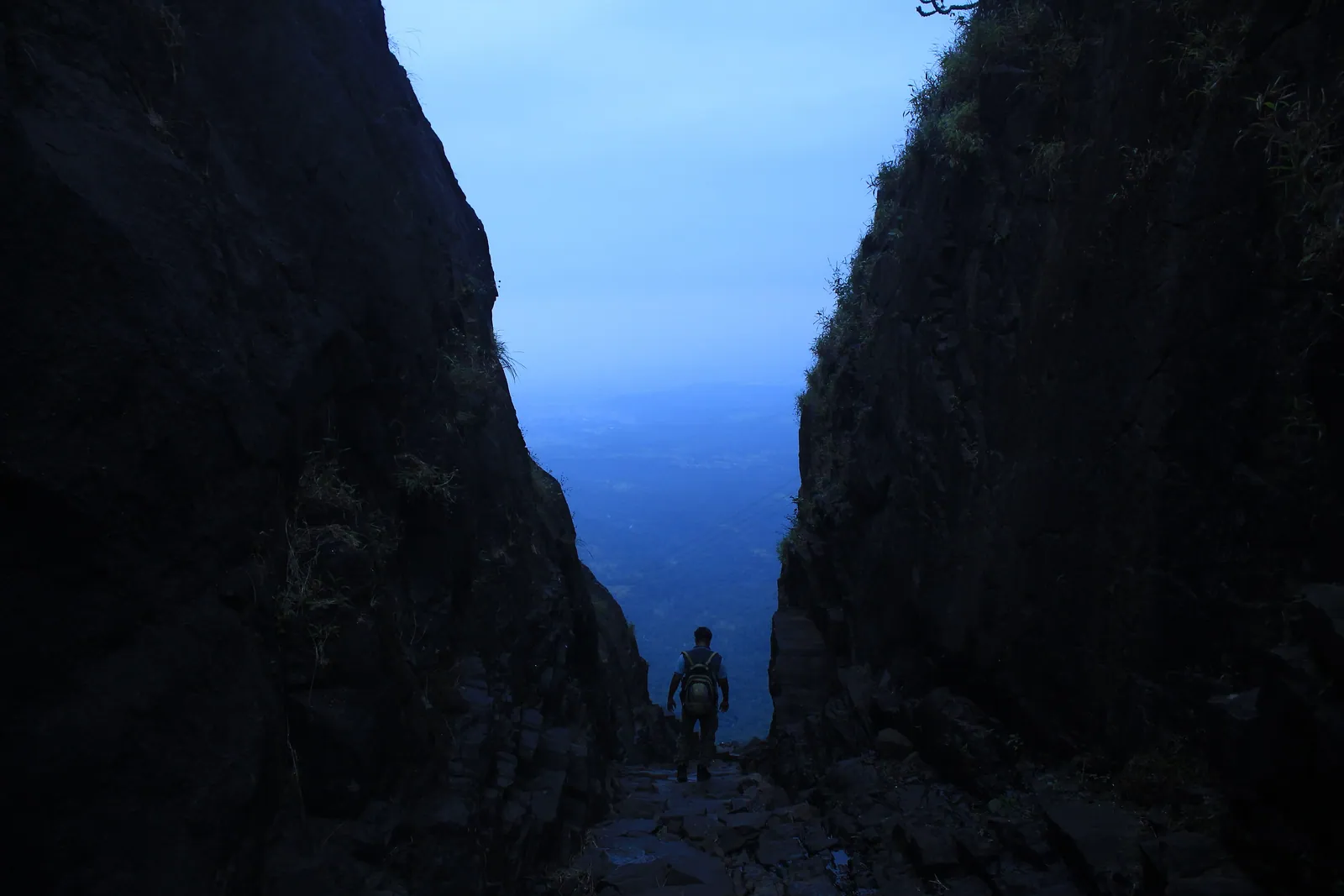
Two thousand years ago, merchants carried goods from the Konkan ports up a narrow gash in the Sahyadri cliff to the Deccan plateau. That pass is Naneghat. Its rock-cut steps, the cave where the Satavahana queen Naganika left one of the most important early inscriptions in India, and the huge stone pot said to have collected tolls are all still there. It is a short, satisfying trek with more history per kilometre than almost anywhere in Maharashtra.
Naneghat at a Glance
- Start: Vaishakhare, on the Kalyan-Malshej road, below the pass
- Top: the plateau near Ghatghar, Junnar taluka
- Climb time: about 2.5 to 3 hours
- Difficulty: easy to moderate; rocky steps in the gorge
- Best season: July to February
- Distance from Mumbai: about 120 km to the base
A Pass With a Long History
Naneghat was a trade route between the Konkan coast, with ports such as Sopara and Kalyan, and the inland towns of the Deccan, including the old Satavahana centres around Junnar and Paithan. The pass was cut and improved in the Satavahana period, around the first or second century BCE, and stepped sections of the old road survive in the gorge.
At the top of the pass is a large cave carrying a long inscription in Brahmi script, recording sacrifices and gifts made by Queen Naganika. It is one of the earliest substantial inscriptions in the region and is important to historians of early Indian kingship and numerals. The cave is protected; look, read the board, and do not touch or mark the walls.
The Climb
From the road near Vaishakhare a trail crosses fields and enters forest, climbing steadily towards the cliff. The final part follows the narrow gorge of the pass itself, up a jumble of boulders and old stone steps, with sheer walls rising on both sides. It is steep but not exposed, and the rock walls make it feel enclosed and dramatic.
In the monsoon the gorge carries a stream, and the rocks are slippery. In heavy rain, water pours down the pass, and the trek becomes much more serious.
Nanacha Angtha and the Toll Pot
Above the pass, a huge pinnacle known as Nanacha Angtha, Nana's thumb, gives a superb view along the Sahyadri wall and down into the Konkan. Near the top of the steps sits a large carved stone pot, popularly said to have been used to collect tolls from traders using the route.
Nearby forts include Jivdhan, reachable from Ghatghar, which can be combined with Naneghat for a fuller day.
The Reverse Waterfalls
In the monsoon, strong winds blowing up the cliffs from the Konkan can push small waterfalls back upwards, so that the water seems to fall towards the sky. Naneghat is one of the best places in the Sahyadri to see this, typically on windy days from July to September. Watch from a safe distance; the edges are wet and the wind is strong.
When to Go
- July to September: waterfalls and reverse waterfalls; slippery in the gorge
- October to February: dry, clear and pleasant; the most comfortable season
- March to May: hot in the lower open section; start early
Getting There
- From Mumbai: about 3 hours by road via Kalyan and Murbad towards Malshej
- By bus: ST buses on the Kalyan-Malshej route stop near Vaishakhare
- From Pune: via Junnar to Ghatghar, which reaches the top of the pass
Frequently Asked Questions
Walk an Ancient Trade Route
Find upcoming Naneghat and Malshej treks from Mumbai and Pune.
Browse Upcoming TreksKeep Reading
More from the TrekVerse journal: