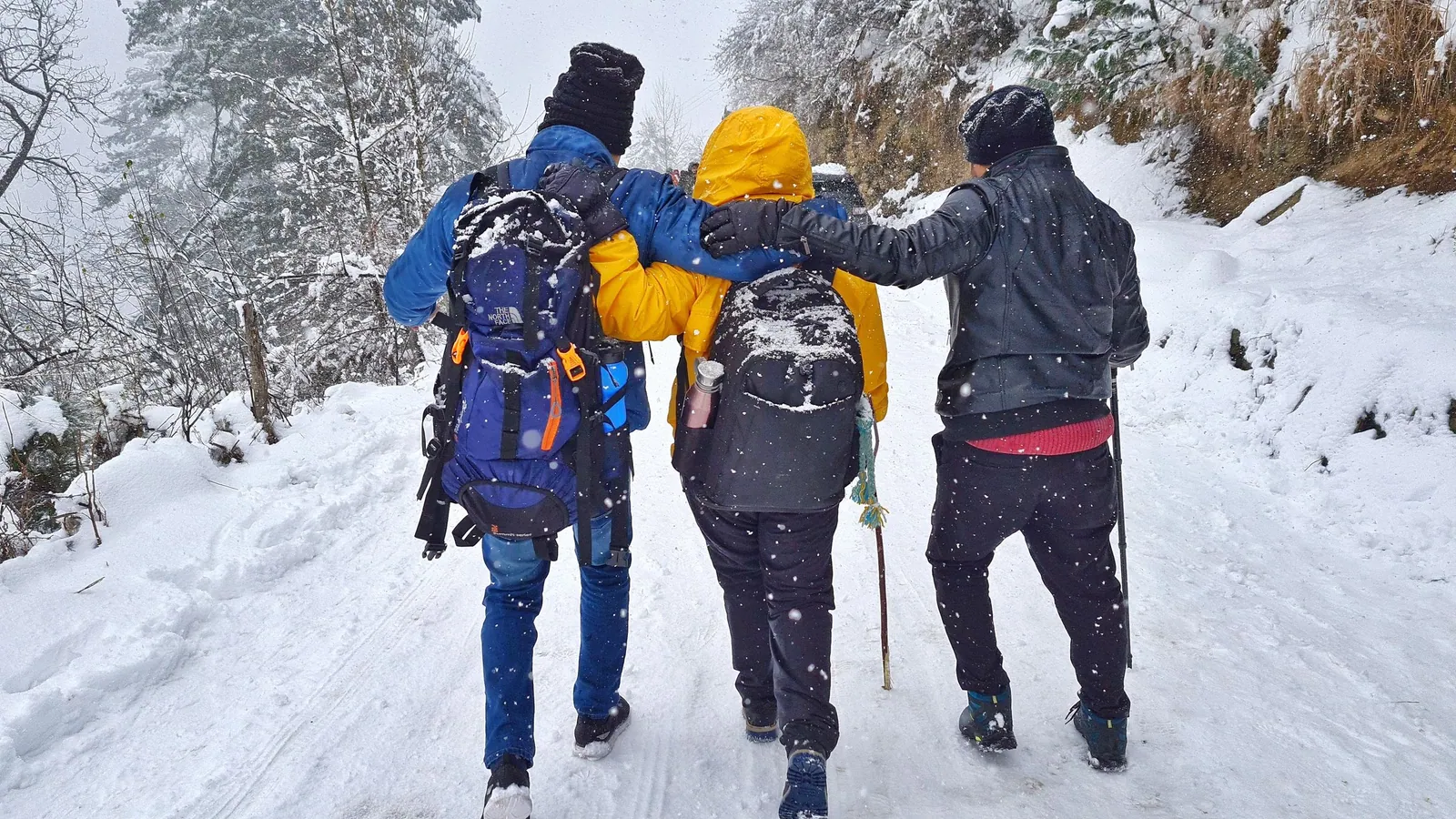
Every weekend, thousands of Indians get into a vehicle at 5am with people they have never met, drive to a village they have never been to, and walk up a mountain together. It works overwhelmingly well, which is easy to forget when you are deciding whether to do it for the first time. But the reason it works is not luck, and the risks are not the ones most people worry about. Here is an honest assessment of where the actual risk sits, and the nine checks that reduce it.
The Risk Is Not Where You Think It Is
Most first-timers worry about the other participants. In practice, participants are the least of it. The things that actually go wrong on Indian group treks, in rough order of frequency, are: slips and falls on the descent, dehydration and heat exhaustion, groups getting separated on unmarked trail branches, road accidents on the drive, and altitude sickness on Himalayan routes. Almost every one of these is a function of how the trek is run rather than who is on it.
This reframing is useful because it changes what you check. Reading a stranger's social media tells you nothing about whether you will be safe. Knowing that there are three trek leaders for thirty people, that they carry a first aid kit, and that they know which hospital is nearest tells you a great deal. Judge the operation, not the people.
1. The Trek Leader Ratio
This is the most informative single number about any group trek and the one most rarely published. Ask directly how many leaders accompany the group on your specific departure. Roughly one per twelve to fifteen on a moderate Sahyadri day trek, and closer to one per eight to ten at Himalayan altitude, is a reasonable expectation.
The ratio matters for one concrete reason: it determines whether the group can split. When somebody twists an ankle or runs out of energy two hours from the road, a group with adequate leaders sends one down with them and continues. A group with a single leader and forty people faces a genuinely bad choice. An operator who cannot state the number for your departure is usually running a ratio they would prefer not to disclose.
2. A Specific Evacuation Plan
Ask what happens if someone cannot walk. The answer should be specific and immediate: who carries the first aid kit, who decides to evacuate, how a person is moved off the trail, which hospital is nearest, and how a family member is contacted. Experienced operators answer this without pausing because they have been asked and, more importantly, have used it.
What you are listening for is process rather than reassurance. An operator who responds with nothing has ever happened on our treks is describing their luck, not their plan. On Sahyadri trails in monsoon, the gap between the two closes with some regularity.
3. How Transport Is Arranged
Statistically, the drive is the most dangerous part of an Indian weekend trek, and it receives the least scrutiny. Overnight departures mean a driver working through the night, tired participants, and highways at their worst hours.
Ask whether transport is arranged by the operator with a professional driver and a fixed pickup list, or self-arranged through a carpool coordinated in a group chat. Both happen constantly; they are not equivalent. If you are joining a carpool with people you have not met, send the vehicle number and driver's contact to someone at home before you get in, and prefer a public, well-lit pickup point over a residential address.
4. Whether the Route Matches Your Fitness
A large share of trek incidents come down to a mismatch between participant and route rather than anything going wrong on the mountain. Someone books a trek on the strength of a photograph, discovers the route is considerably harder than expected, and runs out of capacity at the point where turning back is hardest.
Prevent this by getting the specifics before booking: which route up the mountain, total distance, elevation gain, and realistic timings including the descent. If the listing names only a destination and not a trail, ask. Be equally honest about your own fitness — a trek leader can plan around a candid answer and cannot plan around a flattering one.
5. A Paper Trail That Survives
This is a safety measure even though it looks like an administrative one. A booking that exists only as a WhatsApp message and a UPI transfer to a personal account leaves you with nothing if the trek is cancelled, if the itinerary changes materially, or if there is an incident and questions arise afterwards about what was promised.
Pay a registered business account or a platform. Get the trek name, date, fee, inclusions and cancellation terms in a message before you pay. Screenshot it. This takes two minutes and resolves the overwhelming majority of disputes in Indian group trekking, most of which are disagreements about expectations rather than deliberate misconduct.
6, 7 and 8: Season, Sharing and Signal
Three checks that are quick to make and disproportionately useful, particularly for monsoon Sahyadri treks and Himalayan departures.
- Season: monsoon Sahyadri trekking is the most beautiful and the most incident-prone. Wet rock, swelling stream crossings and low visibility all compound. Choose an appropriate route and an operator who has run it in rain, not just in October.
- Sharing: send one specific person the trek name and date, the organiser's name and number, the vehicle number, and when you expect to be back in signal. The point is that somebody notices if you do not check in.
- Signal: most Sahyadri trailheads and nearly all Himalayan routes have no reliable network. Assume you will be uncontactable, tell people so in advance, and carry a power bank — a dead phone cancels out every other precaution you took.
9. What the Group Itself Tells You
Having established that participants are rarely the risk, there is one genuine exception worth naming: a group where nobody is in charge. Informal treks organised in a WhatsApp group with no designated leader, no first aid kit, and no agreement about who makes decisions are the format where things most often go wrong, because when a decision is needed there is no mechanism to make one.
This is not an argument against peer-hosted treks, which are often excellent. It is an argument for asking who is leading before you go. A named person who has done this route before, carries a kit, and is willing to make the call to turn the group around is the entire difference between a well-run community trek and a group of friends improvising at altitude.
What Genuinely Reduces Risk, In Order
If you do only a few things, do these. They are ordered by how much difference they actually make.
- Match the route to your real fitness, and be honest with the organiser
- Confirm the trek leader ratio for your specific departure
- Confirm the evacuation plan is a process, not a reassurance
- Tell one specific person your plan and expected return time
- Pay a business account and keep a written confirmation
- Choose the season deliberately, especially for Sahyadri monsoon routes
- Go slower on the descent than on the ascent
- Carry your own water, medication and a power bank regardless of what is provided
Frequently Asked Questions
Trek With Groups You Can Check
Every trek on TrekVerse publishes its organiser, group size, difficulty and inclusions up front — so the checks in this guide take a minute, not an afternoon.
Browse Verified TreksKeep Reading
More on trekking safely in India: