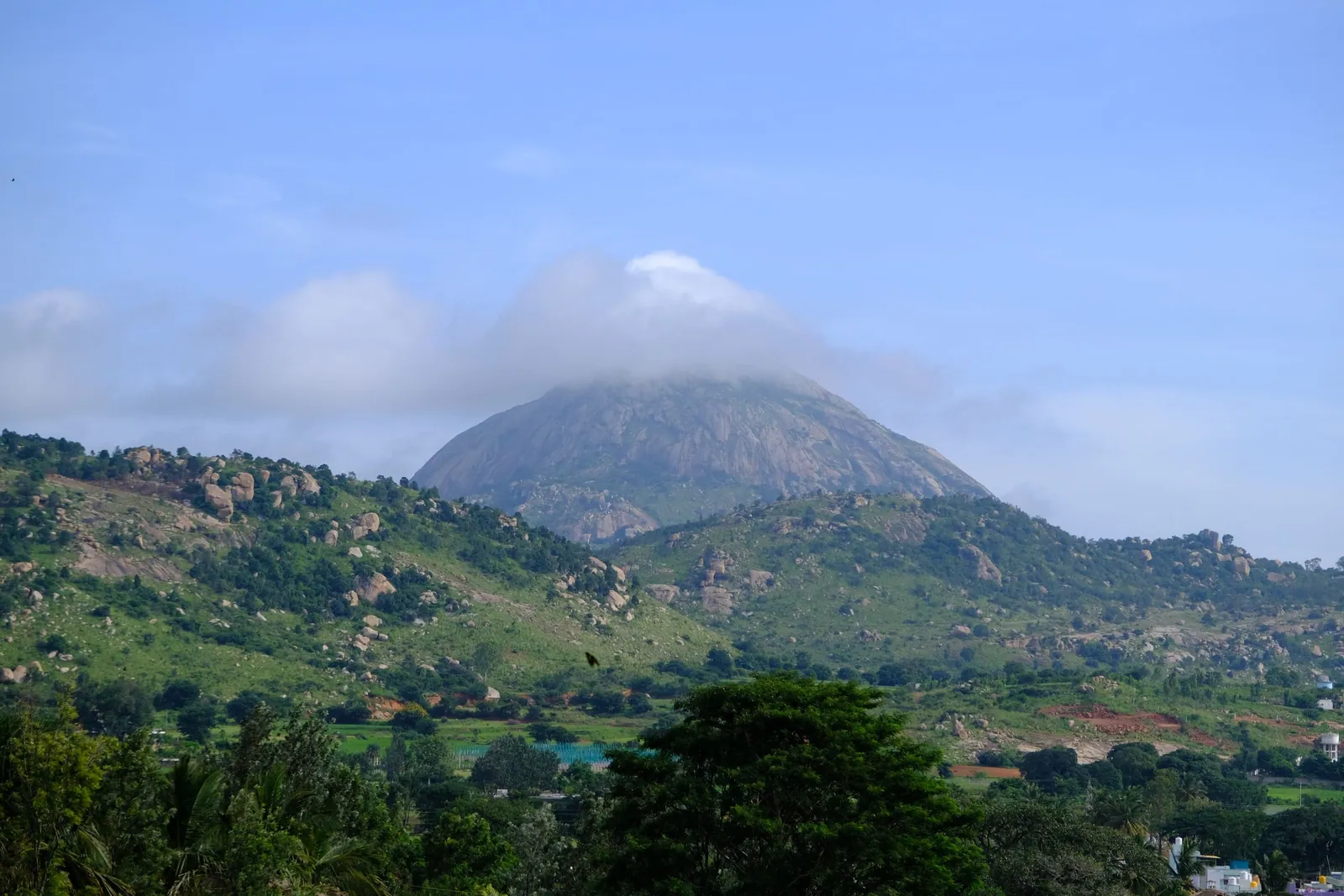
Bangalore sits within reach of some of the Western Ghats' finest trekking country, plus a cluster of granite hills right on its doorstep. Whether you want a two-hour sunrise climb or a demanding two-day Western Ghats trek, here are the best weekend trekking options near Bangalore, with real distances and difficulty so you can plan the right trip for your group.
Treks near Bangalore fall into two broad categories, and it's worth knowing which one you're signing up for before you plan a weekend around it. The first is the rocky hill belt around Nandi and Chikballapur, close enough — under 100 km in every case — to squeeze into a half-day or sunrise outing without touching your Saturday plans. The second is the proper Western Ghats country further west and south towards Chikmagalur, Kudremukh, and Kodagu, which asks for a full weekend or a two-day trip and rewards it with a completely different kind of trekking: dense forest, grassy ridgelines, and views that have nothing to do with the Deccan plateau you left behind. Both categories are worth doing, just for different weekends and different moods.
The terrain itself shapes what each trek feels like more than distance does. The granite hills close to the city — Nandi, Skandagiri, Savandurga, Anthargange — are exposed, sun-baked, and largely treeless, so they reward early starts and punish anyone who shows up at noon expecting shade. The Western Ghats treks further out are the opposite: dense, humid, forested, and considerably cooler even in peak summer, which is exactly why Kudremukh and Kumara Parvatha feel like a different country altogether despite being reachable within a single day's drive from Bangalore. Knowing this distinction before you pick a trek saves a lot of disappointment — nobody wants to discover mid-climb that the 'green Western Ghats trek' they signed up for is actually a bare granite scramble, or vice versa.
- Nandi Hills — ~60 km, easiest, popular sunrise spot
- Skandagiri (Kalavara Durga) — ~70 km, easy-moderate night/sunrise trek
- Savandurga — ~50 km, moderate, one of Asia's largest monolith hills
- Anthargange — ~65 km, easy-moderate, caves and rock formations
- Kudremukh — ~350 km, moderate-difficult, Western Ghats grasslands
- Kumara Parvatha — ~230 km, difficult, one of Karnataka's toughest treks
1. Nandi Hills — The Easiest Sunrise Trek
Nandi Hills is the trek that pulls half of Bangalore out of bed before dawn on a weekend. The 'trek' itself is more a scenic walk than a climb — the hill is largely drivable, with only short, easy walking trails around fort ruins and terraced gardens once you're up.
What makes it the classic Bangalore outing isn't difficulty but atmosphere: watching the plains below fill with pink light as the sun comes up over Nandi Betta, coffee in hand, is a ritual as much as a trek. It works year-round but is best in the cool mornings between October and February.
- Distance: ~60 km, 1.5-2 hr drive
- Difficulty: Easy (mostly a walk)
- Best time: October-February, sunrise
- Good for: beginners, families
2. Skandagiri (Kalavara Durga) — Night Trek to Sunrise
Skandagiri, about 70 km from the city, is the natural step up once Nandi Hills starts to feel too easy. Most trekkers do it as a night trek — starting the rocky ridge climb well after dark with headlamps, so the final stretch to the summit coincides with first light.
On a good morning between October and February, the payoff is a genuine sea of clouds filling the valley below while the sky turns from black to orange, followed by a walk around the ruins of an old fort scattered across the summit rocks. The ridge is exposed, so it's best attempted with a known group.
- Distance: ~70 km
- Difficulty: Easy-moderate (night trek)
- Best time: October-February
- Highlight: sea-of-clouds sunrise
3. Savandurga — One of the Largest Monolith Hills in Asia
Savandurga, roughly 50 km out, is where the hills around Bangalore start demanding real effort. The trek climbs across two peaks, Karigudda and Biligudda, of a single massive granite monolith — one of the largest in Asia — with some steep, ropeless sections that call for confident footwork.
There's essentially no shade anywhere on the ascent, so this is a trek for the cooler months; midday heat on bare granite is punishing, and the same rock turns dangerously slick in rain. For a trek within an hour of the city, Savandurga delivers a surprisingly serious scramble.
- Distance: ~50 km
- Difficulty: Moderate, exposed rock climb
- Best time: October-February
- Avoid: midday heat, wet granite
4. Anthargange — Caves, Boulders, and a Short Adventure
Anthargange, near Kolar about 65 km from Bangalore, packs an unusual amount of variety into a half-day outing. The trail winds through volcanic rock formations and a small network of caves that require a bit of squeezing and scrambling to get through.
This gives the trek a genuine sense of adventure despite being rated easy-to-moderate overall. It's doable year-round, though most pleasant in the cooler months, and its compact size makes it a favourite for a quick weekend plan with friends.
- Distance: ~65 km
- Difficulty: Easy-moderate
- Highlight: cave scrambling
- Best time: year-round, cooler months ideal
5. Kudremukh — A Proper Western Ghats Trek
Kudremukh is where this list stops being a Bangalore day trip and becomes a real Western Ghats expedition — 340 to 360 km away, it's best planned as an overnight or two-day trip rather than squeezed into a single Saturday.
The reward is rolling, grass-covered peaks that feel like nothing else in Karnataka, with sweeping ridge-line views across the Ghats on a clear day. Go between October and February for the clearest visibility, or during monsoon for the grasslands at their greenest.
One practical note that catches people out: Kudremukh requires forest department permission to trek, so this is not a spontaneous plan — sort out the paperwork well in advance.
- Distance: ~340-360 km
- Difficulty: Moderate-difficult
- Best time: October-February (or monsoon for green)
- Note: forest permit required
6. Kumara Parvatha — Karnataka's Toughest Weekend Trek
Kumara Parvatha, reached via Kukke Subramanya around 230 km from Bangalore, has a reputation for a reason. It's steep, long, and physically demanding in a way none of the other treks on this list come close to, climbing through dense forest and grassy ridgelines.
This is strictly a trek for experienced, fit trekkers — the kind of route you graduate to after Savandurga and Kudremukh have stopped feeling hard — and it's best attempted between October and February, since it's often restricted during monsoon. Like Kudremukh, it needs a forest permit.
- Distance: ~230 km via Kukke Subramanya
- Difficulty: Difficult (experienced trekkers)
- Best time: October-February
- Note: forest permit required
Getting There and Making the Most of the Trip
Self-driving is by far the easiest way to reach any of these treks, since bus and shared-cab connections thin out fast once you're past the immediate outskirts of Bangalore, especially for pre-dawn starts like Skandagiri's night trek.
Leaving the city by 4 or 5 a.m. on weekends avoids most of the traffic on the Nandi and Chikballapur routes, and for the Western Ghats treks further out, starting the previous evening and staying overnight near the base makes for a far less exhausting trip.
Many of these treks also sit close to other worthwhile detours: coffee estates and waterfalls around Chikmagalur, temple towns near Kolar, or resort stops on the way back from the granite hills.
Bangalore Weather Through the Year: What It Means for Trekking
Bangalore's own mild climate is a big part of why these treks stay accessible almost year-round compared with the extremes trekkers face further north. The city rarely gets brutally hot or cold, but the hills around it are a different story — Savandurga and Skandagiri sit fully exposed to the sun, so a pleasant day in the city can feel considerably harsher on bare granite by mid-morning.
October through February is the sweet spot across almost every trek on this list, combining cool temperatures, clear skies, and dry trail conditions. March through May brings rising heat that makes exposed granite climbs uncomfortable past mid-morning, pushing most trekkers toward pre-dawn starts.
The June to September monsoon transforms the Western Ghats treks into their greenest form but adds real caution to the granite hills, where wet rock turns hazardous fast — so the right season depends on which category of trek you're planning around.
Building a Trekking Progression Around Bangalore
One underrated way to use this list is as a progression rather than a menu of unrelated options. Someone new to trekking might start with Nandi Hills purely to test whether early starts and outdoor mornings actually suit them, then move to Skandagiri once a sunrise trip with a bit more walking feels comfortable.
From there, Savandurga or Anthargange introduce real physical effort and exposed terrain without demanding overnight logistics, building the fitness and trail-reading instincts that make a longer Western Ghats trek far more enjoyable than intimidating.
Kudremukh is the natural next step once a full day of sustained climbing feels manageable, and Kumara Parvatha sits at the top as the trek worth training toward. Treated this way, the hills around Bangalore form a genuine six-step ladder over a single trekking season.
Packing for Bangalore's Hill Treks
Because most of these treks are close enough to feel like a spontaneous plan, it's tempting to underpack — but the exposed granite hills in particular punish that instinct. At minimum, carry two to three litres of water per person for Savandurga, Skandagiri, or Anthargange, plus a cap and sunscreen for the shadeless sections.
A basic headlamp is worth carrying even on daytime treks, in case a climb runs later than planned, and it's essential for Skandagiri's night trek regardless. For the Western Ghats treks, add a light rain layer even outside monsoon, since weather in the hills can shift faster than in the city.
Proper trekking shoes rather than regular sneakers matter too — the loose scree and wet grass on Kudremukh and Kumara Parvatha are far less forgiving of smooth soles than the packed granite closer to Bangalore.
- Water: 2-3 litres per person (Savandurga/Skandagiri/Anthargange)
- Headlamp — essential for night treks
- Rain layer for Western Ghats treks
- Grippy trekking shoes, not sneakers
Frequently Asked Questions
Find Your Next Bangalore Weekend Trek
Discover upcoming treks near Bangalore, connect with local trek groups, and plan your weekend on TrekVerse.
Explore TreksChoosing the Right Trek for Your Weekend
The right pick really comes down to how much time and fitness you're bringing to the weekend. If you've only got a half-day or want a sunrise trip that doesn't eat into your Saturday, Nandi Hills or Skandagiri are the obvious choices. For a full day with a moderate physical challenge, Savandurga or Anthargange strike the right balance of effort and reward without requiring an overnight stay. If you can free up a full weekend and want genuine Western Ghats scenery, Kudremukh is worth the longer drive and the permit paperwork. And if you're after a serious two-day physical test and already have some trekking experience behind you, Kumara Parvatha is the one that will actually challenge you rather than just tire you out.
Safety Tips
A handful of precautions cover most of what goes wrong on these treks. Carry more water than you think you'll need — the granite hills near Bangalore, especially Savandurga and Skandagiri, have almost no shade and no reliable water sources along the route, so dehydration sneaks up faster than expected. Avoid the Savandurga and Anthargange trails during or immediately after rain, since wet granite turns treacherously slippery on exactly the exposed sections where a fall would matter most. For Kudremukh and Kumara Parvatha specifically, check the current forest department permit rules and any seasonal restrictions before you travel, since these change and can derail a trip planned without checking first. And for night treks like Skandagiri, stick to a known group or an organised batch, and carry headlamps and warm layers — it gets noticeably colder on an exposed ridge at 3 a.m. than the daytime temperature would suggest.
More Trekking Guides
Continue planning your next trek with TrekVerse: