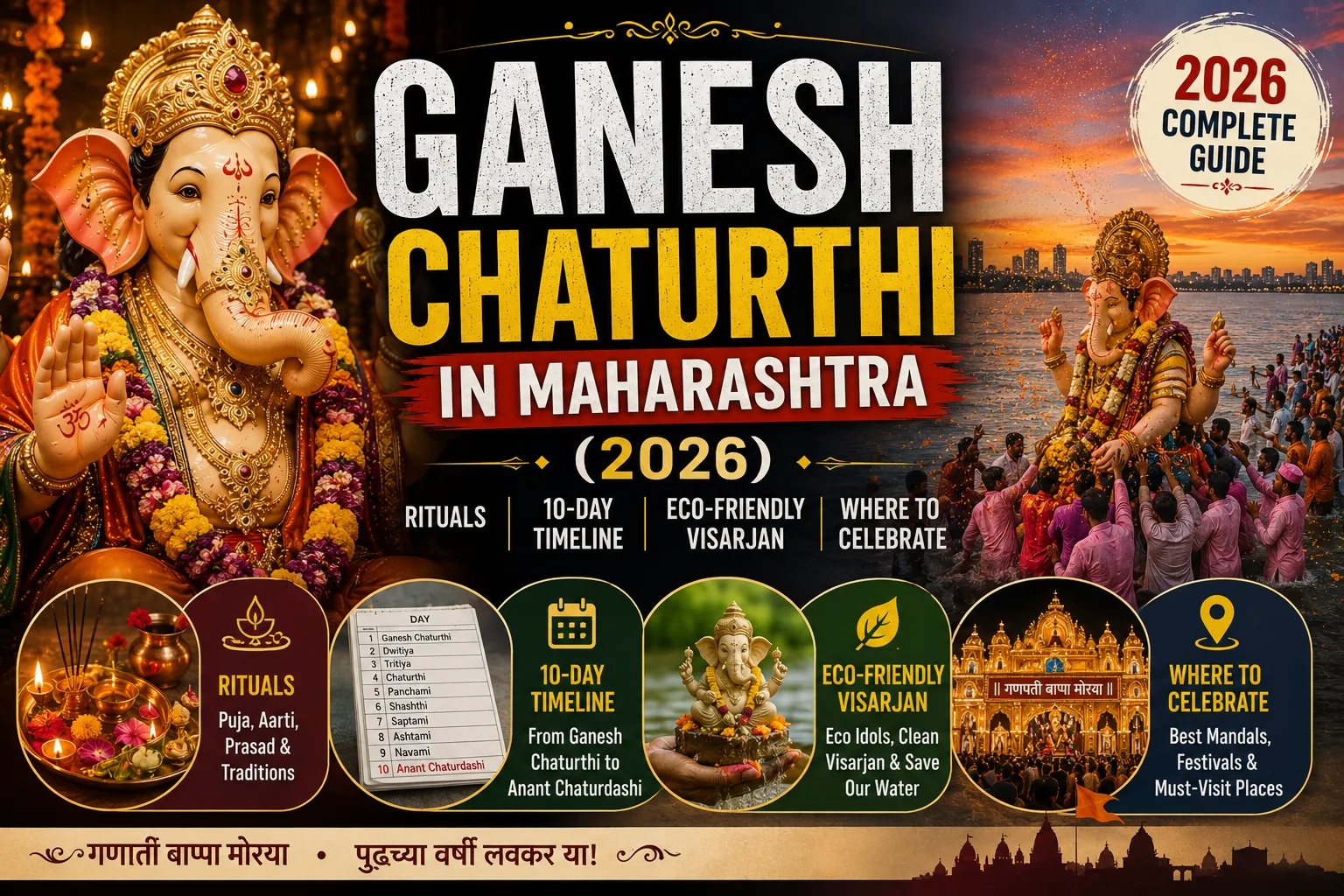
Ganesh Chaturthi is Maharashtra's biggest festival by a distance - ten days that empty offices, fill trains, shut roads and turn entire neighbourhoods into shared living rooms. This guide explains what actually happens across those days, how the household and mandal rituals differ, how to do it without wrecking a river, and which parts of the state give you which version of the festival.
The festival marks the birth of Ganesha and begins on Bhadrapada Shukla Chaturthi, which falls between late August and mid-September depending on the lunar calendar. It ends on Anant Chaturdashi with visarjan, the immersion.
There are really two festivals running in parallel: the household one, quiet and ritual-heavy, and the sarvajanik one, loud and public, which Lokmanya Tilak turned into a mass event in Pune in 1893. Most Maharashtrians participate in both.
Why Ganeshotsav Took Over Maharashtra
- It was deliberately built as a public institution in 1893, and that organising structure - the neighbourhood mandal - still exists and still runs year-round community work.
- It is genuinely open. Anyone can walk into any pandal, regardless of who they are, at no cost.
- It gave Maharashtra its own mass performing-arts tradition: dhol-tasha pathaks, lezim, and the mandal cultural programmes.
- Its craft economy is enormous - idol sculpture, pandal construction, decoration, sweets - and much of it is seasonal work for the same families across generations.
- The farewell, 'Pudhchya Varshi Lavkar Ya', builds an annual return into the festival itself.
When It Falls and When to Go
Ganesh Chaturthi begins on Bhadrapada Shukla Chaturthi and ends eleven days later on Anant Chaturdashi, landing between late August and mid-September depending on the year - check a Marathi panchang for the exact 2026 dates before booking anything. For visiting mandals, days two to five on a weekday are best. For the processions, target the aagman day at the start or Anant Chaturdashi at the end, and accept the crowds that come with them.
The Ten-Day Timeline
Not every household follows all ten days, but the sequence below is the full version as most mandals observe it.
- Day before - Aagman: the idol is brought home or to the pandal in procession, often with dhol-tasha. In Mumbai and Pune, mandal aagman processions are events in their own right.
- Day 1 - Sthapana and Pranapratishtha: the idol is installed, and the ritual invites the deity to reside in it for the duration. Followed by the first aarti and a naivedya of ukadiche modak.
- Days 2 to 4 - daily morning and evening aarti, visitors, and continuous naivedya offerings. Mandal decorations are complete by now, and this is the best window to visit.
- Day 5 - a common immersion day for households, particularly those who do not host Gauri.
- Days 5 to 7 - Gauri Avahan, Gauri Pujan and Gauri Visarjan: the Gauri (Mahalakshmi) idols arrive, are worshipped with an elaborate feast, and depart. This is the most food-intensive part of the festival in most households.
- Day 7 - the second common household immersion day.
- Days 8 to 10 - the crowds peak. Mandals run cultural programmes, competitions and social-cause camps, and public spaces become genuinely difficult to move through.
- Day 11 - Anant Chaturdashi: the great visarjan. Processions run all day and often through the night, ending at the sea, rivers, lakes or artificial immersion tanks.
The Household Rituals, Briefly
- Pranapratishtha: the installation ritual that consecrates the idol, usually performed by a family elder or a priest on day one.
- Shodashopachara puja: the sixteen-step worship, offered in shortened form on ordinary days and in full on the main ones.
- Naivedya: the food offering. Ukadiche modak on day one is near-universal; through the rest, families offer whatever is cooked that day.
- Aarti: morning and evening, with 'Sukhkarta Dukhharta' - written by Samarth Ramdas in the seventeenth century - sung in essentially every Maharashtrian home.
- Uttarpuja: the closing ritual performed just before the idol leaves the house, releasing the deity from the idol.
- Visarjan: the idol is immersed with a formal farewell, and the household says 'Ganpati Bappa Morya, Pudhchya Varshi Lavkar Ya' - come back soon next year.
1.5, 5, 7 or 10 Days - Why Families Differ
There is no single correct duration. Families follow whatever their household tradition (kul-achar) has always followed, and switching is uncommon.
The one-and-a-half-day tradition - dedh divas - is very widespread, particularly among families who also host Gauri separately or who travel for the festival. Five and seven days are the most common household choices in Pune and Mumbai. The full ten to eleven days is standard for sarvajanik mandals and for households with a long-standing tradition of it.
Practically, this staggering is what makes the festival manageable: immersions spread across four or five separate days rather than everything landing on Anant Chaturdashi at once.
Doing It Eco-Friendly (This Genuinely Matters)
Maharashtra immerses an enormous number of idols in a two-week window. The difference between a clay idol and a POP one, multiplied at that scale, is the difference between a festival and a pollution event.
- Choose shadu mati (natural river clay). It dissolves fully within hours and leaves no residue. Paper-mache and seed idols - which sprout into a plant after immersion - are equally good options.
- Avoid plaster of Paris. It does not dissolve, and the chemical paints on POP idols release heavy metals into water bodies. Several municipalities now restrict POP idols above a set height.
- Use natural colours. Unpainted or vegetable-dyed idols are increasingly available and cost very little more.
- Immerse in the municipal artificial ponds. Every ward operates them now, they are free, and they are a short walk from most neighbourhoods.
- Home immersion in a bucket or drum works perfectly for small shadu mati idols, and the clay can be returned to a garden or a plant pot.
- Separate the nirmalya - flowers, leaves and offerings - into the collection bins provided rather than throwing it into the water. Most of it is composted.
- Skip thermocol decorations. Cloth, paper, bamboo, coconut fibre and real flowers look better and do not persist for a century.
The Food: Modak and Everything Around It
- Ukadiche modak - steamed rice-flour shells filled with fresh coconut and jaggery, served hot with ghee. The signature naivedya, and genuinely worth learning to make.
- Fried modak - the keeping version, made with wheat flour. Common as prasad because it survives a day in a box.
- Puran poli - flatbread stuffed with sweetened chana dal, standard on the Gauri Pujan feast day.
- Karanji, ladu and shrikhand - the supporting sweets, present in almost every household through the ten days.
- The Gauri feast: usually sixteen bhajis, puran poli, bhaji-bhakri and a full sit-down thali. The biggest home-cooked meal of the Maharashtrian year.
- In Konkan households, expect the same festival with more coconut and kokum, and fish returning to the table only after visarjan.
Where to Experience It - Region by Region
- Pune - the birthplace of the public festival, the five Manache Ganpati, Dagdusheth, hundreds of dhol-tasha pathaks and a mandal circuit you can walk end to end in one night. The most accessible version for a visitor.
- Mumbai - the scale version. Lalbaugcha Raja, Mumbaicha Raja, GSB Seva Mandal and a visarjan procession to Girgaon Chowpatty that is one of the great urban spectacles anywhere.
- Konkan (Ratnagiri, Sindhudurg, Raigad) - the most traditional household version. Entire villages empty out in the cities and refill for ten days, and Ganpatipule in particular sees enormous crowds. Book transport months ahead: the Konkan Railway sells out early and the Mumbai-Goa highway is solid for two days each way.
- Ashtavinayak circuit - the eight ancient Ganesha temples around Pune district. Doing the yatra during Ganeshotsav is popular and correspondingly crowded; the shoulder weeks are far more pleasant.
- Nashik, Nagpur and Kolhapur - large mandal cultures of their own with a fraction of the visitor pressure, and much easier to move around in.
Practical Planning Notes
- Book long-distance travel two to three months out. The Konkan Railway, Mumbai-Pune buses and Mumbai-Goa road traffic all saturate around the festival.
- Expect road closures and diversions in the old cities of Pune and Mumbai for most of the ten days, and full closures on Anant Chaturdashi.
- Many businesses run reduced hours during the last three days. If you have work in Maharashtra that week, assume delays.
- Loud music is common until late, though courts have set decibel and time limits that most mandals now observe.
- The monsoon overlaps with the festival. Carry rain gear on any day you plan to be out for hours.
- If you are visiting a household, take fruit, flowers or sweets, and remove your footwear before approaching the idol. Photography of the household idol is usually welcome, but ask first.
Staying Safe in Festival Crowds
- Fix a physical meeting point with your group before you enter any crowded area - mobile networks fail reliably during peak hours.
- Move with pedestrian flow and follow police one-way arrangements rather than looking for shortcuts.
- Keep valuables in front pockets or zipped bags; theft peaks during the final three days and on visarjan day.
- At immersion points, stay off the water's edge unless you are part of an immersion party. Drownings happen every year at sea and river immersions.
- Carry water and take breaks. Multi-hour queues in September humidity cause more problems than the crowds themselves.
- If you have young children with you, write your phone number on their arm or a wristband. Volunteers at every large mandal are used to reuniting families, and this makes it instant.
Frequently Asked Questions
Keep Reading
More on Ganesha and Maharashtra's festivals:
Final Thoughts
Ganesh Chaturthi is at its best when you experience both halves of it - a household aarti with fresh modak, and one night walking a mandal circuit with a hundred thousand other people. One without the other only shows you half the festival.
Whichever version you choose, the eco-friendly decisions are the ones that matter most: shadu mati, natural colours, artificial immersion ponds, nirmalya in the bins. None of it costs much, and at Maharashtra's scale it changes the outcome for every river the state has.
- Days two to five, on a weekday, for the best mandal visits.
- Shadu mati idol, natural colours, artificial immersion pond.
- Book intercity travel two to three months ahead.
- Pune for the walkable circuit, Mumbai for the scale, Konkan for the tradition.