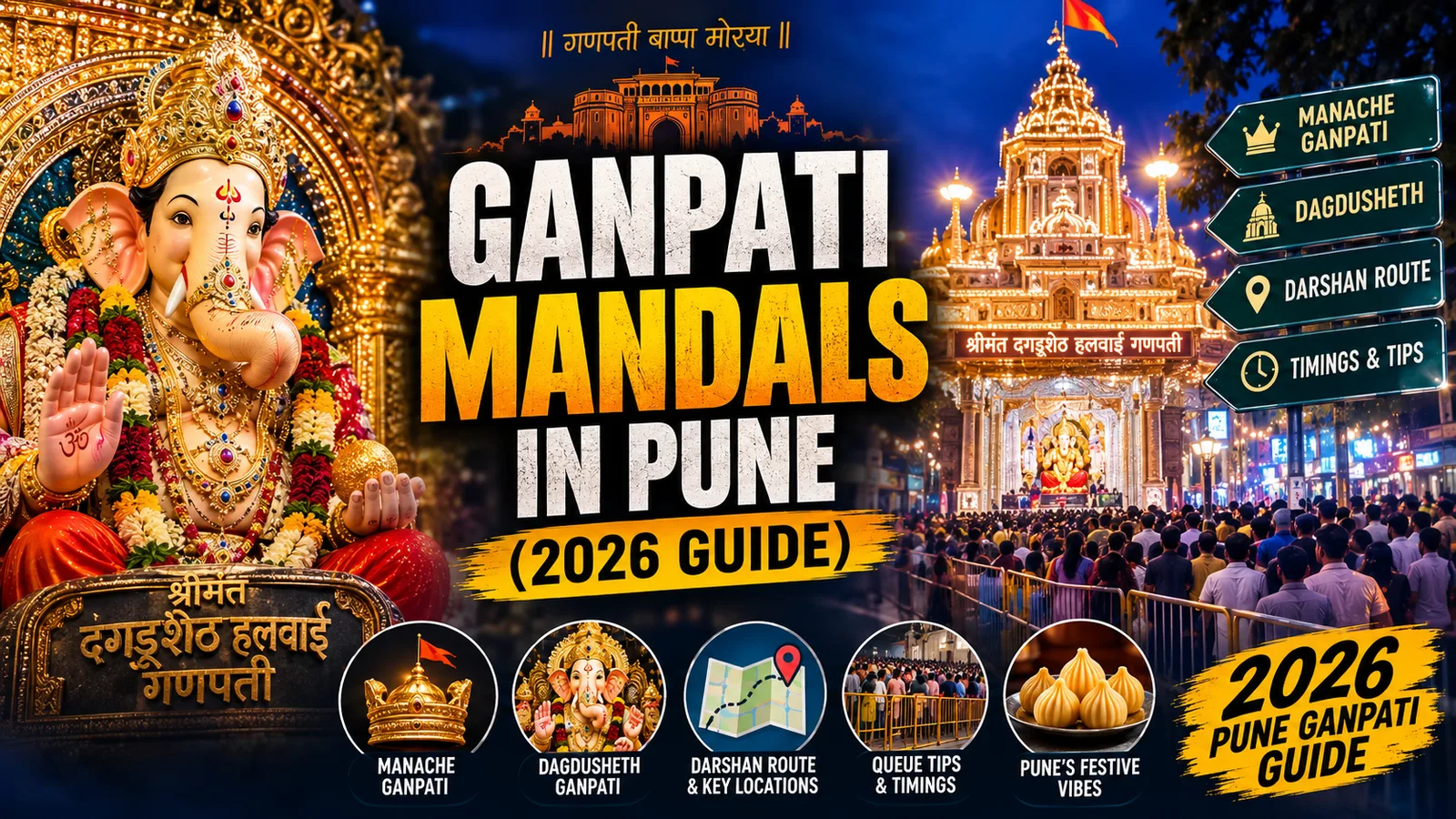
For eleven days every year, Pune's old peth lanes turn into one enormous open-air gallery. Ganeshotsav as a public festival was born here in 1893, and the city still does it better than anywhere else - hundreds of mandals, five that carry ceremonial seniority, and a walking circuit you can genuinely finish in a single night if you plan it right. This is the practical guide: who to see, in what order, when to go, and how to avoid the crush.
Pune's Ganeshotsav is walkable in a way Mumbai's is not. Almost every mandal that matters sits inside the old city - Kasba Peth, Budhwar Peth, Ganesh Peth, Narayan Peth and the Laxmi Road stretch - so a single well-ordered loop covers the famous names without a single auto ride.
The trade-off is crowd density. Laxmi Road on a Saturday night during the last three days is one of the densest pedestrian spaces in the country. Go early in the festival, go early in the day, or accept that you will be moving at fifteen minutes per kilometre.
What Makes Pune's Ganeshotsav Different
- It is the birthplace of the public festival, and the five Manache Ganpati preserve a ceremonial order that exists nowhere else.
- The entire core circuit is walkable - no other Indian festival of this scale is this easy to do on foot.
- Dhol-tasha pathaks: hundreds of trained volunteer troupes, many with a large share of women players, rehearsing for months.
- The mandals lean into mythological and social-message tableaux rather than pure spectacle, which makes each one worth actually stopping at.
- Dagdusheth's temple stays open year-round, so the city's most famous Ganpati is not a once-a-year darshan.
Best Time to Plan Your Visit
Ganesh Chaturthi falls on Bhadrapada Shukla Chaturthi, which lands somewhere between late August and mid-September depending on the year - check a Marathi panchang for the exact 2026 dates before booking. Arrive for days two to five of the festival for the best balance of complete decorations and survivable crowds, and keep Anant Chaturdashi free if you want to see the visarjan miravnuk.
Why Pune Is Where Sarvajanik Ganeshotsav Began
Ganesh Chaturthi was a household festival for centuries before it became a street one. In 1893, Lokmanya Bal Gangadhar Tilak promoted the public Ganeshotsav in Pune as a way for people to gather, organise and hear speeches at a time when colonial law restricted political assembly. Mandals sprang up across the peths, each one run by a neighbourhood committee.
That origin still shapes the festival here. Pune mandals lean towards tradition - brass bands, dhol-tasha pathaks, mythological tableaux and social-message displays - rather than the giant themed pandal spectacle Mumbai is known for. Both are worth seeing; they are simply different festivals wearing the same name.
The Five Manache Ganpati (In Order)
'Manache' means 'of honour'. These five mandals hold ceremonial seniority, and they lead the visarjan procession in this exact sequence. Visiting them in order is the classic Pune darshan.
- 1. Kasba Ganpati, Kasba Peth - the gramdaivat (presiding deity) of Pune, linked to Jijabai and the earliest settlement of the city. Small, unshowy, and the first idol to enter the immersion procession every year.
- 2. Tambdi Jogeshwari, Budhwar Peth - beside the Jogeshwari temple. The idol is immersed and freshly sculpted each year rather than reused, which is unusual among the big mandals.
- 3. Guruji Talim, Ganesh Peth - founded in 1887, before Tilak's public festival, by a group that included both Hindu and Muslim residents. It is still cited as the city's oldest symbol of communal partnership, and it grew out of a talim (a traditional wrestling gym).
- 4. Tulshibaug Ganpati, Tulshibaug - known for its tall fibreglass idol and elaborate decoration. It sits inside the busiest shopping lane in the old city, so approach it from the Laxmi Road side.
- 5. Kesariwada Ganpati, Narayan Peth - the Tilak family's own mandal, held at Kesari Wada, the house from which Tilak published the Kesari newspaper. The most historically loaded stop on the route.
The order is fixed and non-negotiable in Pune. If you only have two hours, do these five and nothing else.
Shrimant Dagdusheth Halwai Ganpati
The single most visited mandal in Pune, and the one most visitors mean when they say 'Pune Ganpati'. It was founded in 1893 by the sweet-maker Dagdusheth Halwai and his wife Lakshmibai after they lost their son in a plague epidemic. The idol is gold-ornamented, insured for a large sum, and instantly recognisable.
Unlike the mandals, Dagdusheth has a permanent temple in Budhwar Peth that is open through the year, so you can get darshan in January just as easily as during Ganeshotsav. During the festival, expect a queue that can run over an hour at peak times and a temporary decorated mandap built around the temple, usually recreating a famous temple facade.
Practical tip: the early-morning aarti window, roughly 6 to 7 AM, is the best darshan of the day. The temple also runs a well-organised queue system, so it moves faster than its length suggests.
Other Mandals Worth Your Time
- Shrimant Bhausaheb Rangari Ganpati, Budhwar Peth - widely credited as the first sarvajanik Ganpati in Pune (1892), a year before Tilak's public call. The idol is distinctive: Ganesha shown slaying a demon, in a wooden form preserved for over a century.
- Akhil Mandai Mandal, Mandai - famous for its Ganpati-and-Sharda pairing and for elaborate moving tableaux. One of the most photographed decorations in the city.
- Hutatma Babu Genu Mandal, Ganesh Peth - named for the freedom fighter, and known for large-scale social and historical themes rendered as full-set installations.
- Jilbya Maruti Mandal, Ganesh Peth - one of the older neighbourhood mandals, good for seeing the festival at street scale rather than spectacle scale.
- Sarasbaug Ganpati (Talyatla Ganpati) - an eighteenth-century Peshwa-era temple on an island garden, not a festival mandal. Worth adding in daylight if you want a calm counterpoint to the peth crowds.
- Dashabhuja Ganpati, Kothrud - a ten-armed idol in a quiet old temple away from the main circuit. Good for anyone staying on the west side of the city.
The Walking Darshan Route (4-6 Hours)
This is the practical sequence. It respects the Manache order where possible and keeps backtracking to a minimum. Start at Kasba Peth; end at Mandai or Narayan Peth.
- Start: Kasba Ganpati (Kasba Peth). Park near Shaniwar Wada or arrive by bus - do not attempt to drive further in.
- Walk to Tambdi Jogeshwari (Budhwar Peth) - about 700 m.
- Continue to Shrimant Bhausaheb Rangari Ganpati - a short detour of a few minutes from Tambdi Jogeshwari.
- Guruji Talim (Ganesh Peth) - roughly 900 m, through some of the densest lanes of the route.
- Tulshibaug Ganpati - enter from the Laxmi Road end, not through the market lanes, which choke completely after 8 PM.
- Shrimant Dagdusheth Halwai Ganpati (Budhwar Peth) - the longest single queue of the night; budget 45 to 90 minutes at peak.
- Akhil Mandai Mandal (Mandai) - about 800 m, and a good place to eat.
- Kesariwada Ganpati (Narayan Peth) - the final Manache stop, and a quieter end to the walk.
Total walking distance is roughly 4 to 5 km. In free-flowing conditions that is an hour; during Ganeshotsav evenings, plan for four to six.
Best Days and Timings
- Day 1: the aagman (arrival) processions are spectacular but the mandals are still being finished. Great for dhol-tasha, poor for darshan.
- Days 2 to 5: the sweet spot. Decorations are complete, crowds are manageable on weekdays, and queues move.
- Days 6 to 10: crowds climb steeply, especially on weekends and on Anant Chaturdashi eve.
- Morning 6 AM to 10 AM: the shortest queues of the entire day, and the best light for photographs of the idols.
- Evening 9 PM to 1 AM: the full lit-up experience with working decorations and live tableaux. Weeknights are far better than weekends.
- Avoid 5 PM to 9 PM entirely - office-hour crowds and family crowds overlap and Laxmi Road slows to a stop.
Getting There, Parking and Transport
- The old city is closed to through traffic for most of the festival. Assume you will walk the last two kilometres regardless of how you arrive.
- Park at Shaniwar Wada, Sarasbaug, Swargate or Deccan and walk in. Paid lots fill by early evening on weekends.
- PMPML runs extra buses through the festival; Swargate and Deccan are the two most useful boarding points for the peth circuit.
- Pune Metro makes Deccan, Mandai and Swargate practical entry points, and is usually the fastest way in on a busy night.
- Ride-hailing surges hard and drivers routinely cancel trips into the peths after 8 PM. Booking a drop at Deccan and walking is more reliable than booking one to the mandal.
- Carry cash. Many food stalls on the route stop taking UPI when the network is congested, and network congestion during Ganeshotsav is guaranteed.
Visarjan Miravnuk: What Actually Happens
On Anant Chaturdashi, the immersion procession begins at Kasba Ganpati in the morning and runs continuously for well over twenty-four hours. The five Manache Ganpati lead in order, followed by hundreds of mandals, each with its own dhol-tasha pathak, lezim troupe or brass band.
The route runs from Kasba Peth through Belbaug Chowk, down Laxmi Road, past Ganpati Chowk and Alka Talkies Chowk, and on towards the river ghats. Immersion increasingly happens in municipal tanks and mobile immersion units rather than directly in the river, which is a genuinely good development for the Mula-Mutha.
If you want to watch: pick a spot along Laxmi Road or near Alka Chowk by mid-morning, or watch the dhol-tasha pathaks at the Kasba Peth start, which is the most atmospheric part of the day and far less crushed than the afternoon stretch.
Food Stops on the Route
- Mandai and Tulshibaug: the best concentration of street food on the circuit - sabudana vada, kothimbir vadi, misal and batata vada from stalls that only appear during the festival.
- Ukadiche modak: the festival's signature sweet. Chitale Bandhu, Kaka Halwai and the peth sweet shops sell them fresh through the ten days.
- Budhwar Peth near Dagdusheth: piyush, amrakhand and lassi stalls that stay open past midnight during the festival.
- Poona Guest House, Shreyas and the older peth thali houses if you want a proper sit-down Maharashtrian meal mid-walk.
- Carry a water bottle. Queues do not let you step out, and hydration is the single most common thing people get wrong on a six-hour night walk.
Photography Notes
- Mornings give you clean, uncrowded frames of the idols; nights give you the decoration and the crowd energy. If you care about images, do the circuit twice.
- Most mandals allow photography of the idol but not video inside the queue. Dagdusheth restricts phone use in the inner queue at peak times - ask a volunteer rather than assuming.
- A phone is genuinely the right tool here. You will be moving in a crowd, and a large camera becomes a liability within an hour.
- The dhol-tasha pathaks during aagman and visarjan are the best photographic subject of the whole festival, and nobody minds you shooting them.
Crowd Safety and Practical Cautions
- Move with the crowd, never against it. On Laxmi Road at peak hours, turning around is genuinely difficult.
- Agree a fixed meeting point with your group before you start - mobile networks fail completely in the peths on busy nights.
- Keep wallets and phones in front pockets or a zipped sling. Pickpocketing rises sharply during the last three days.
- Wear shoes you can walk five kilometres in on uneven, often wet lanes. Sandals and slip-ons are a bad idea.
- If you are with young children or elderly family, do the morning circuit rather than the night one. This is not a compromise - the darshan is better anyway.
- Watch for temporary overhead wiring and generator cables at pandal entrances, especially after rain.
Frequently Asked Questions
Keep Reading
More on Ganesha and Maharashtra's festivals:
Final Thoughts
Pune's Ganeshotsav rewards planning more than stamina. Do the five Manache Ganpati in order, add Dagdusheth and Mandai, walk it on a weekday, and you will have seen the real festival rather than just its most crowded edge.
If you have a second day, spend it differently: watch the dhol-tasha pathaks at dawn on visarjan day, or drive out to the Ashtavinayak circuit while the city is still celebrating.
- Go on a weekday, between days two and five.
- Start at 6 AM for darshan, or after 9 PM for decorations.
- Walk the peth circuit; do not try to drive it.
- Carry cash, water and a fixed meeting point.