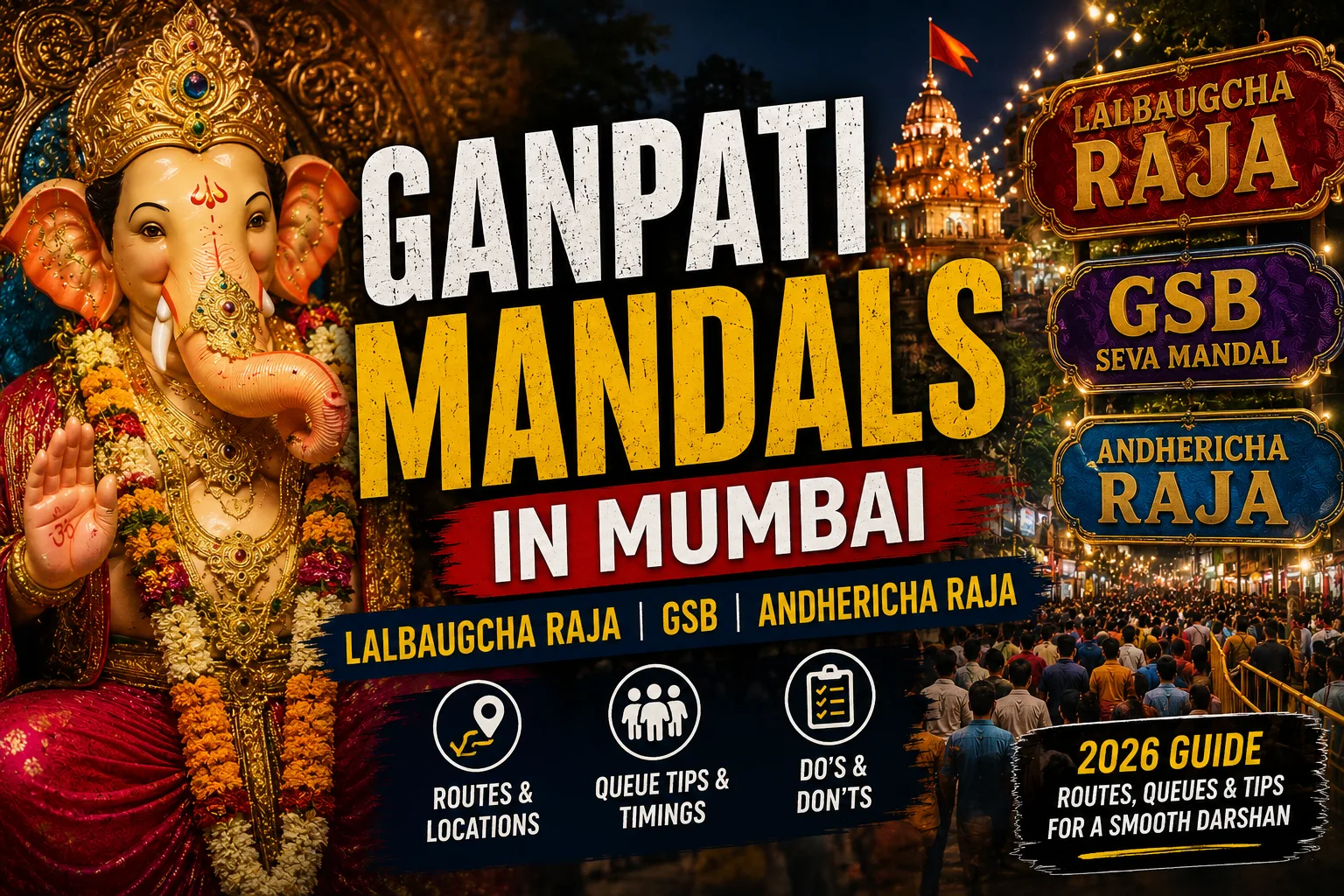
Mumbai's Ganeshotsav is a different animal from Pune's. The mandals are bigger, the idols are taller, the queues are measured in hours rather than minutes, and the whole thing runs on local trains. This guide covers which mandals are worth the time, how the Lalbaugcha Raja queue system actually works, a walking circuit that fits in one evening, and where to be on visarjan day.
The single most useful thing to understand about Mumbai's festival is that the famous mandals cluster. Lalbaug and Chinchpokli hold four of the biggest names within walking distance of each other, which means one well-planned evening covers most of what people travel across the city to see.
The second most useful thing: Lalbaugcha Raja has two entirely separate queues with wildly different wait times, and choosing the wrong one can cost you a full day. Almost every 'the queue was twenty hours' story comes from people who joined the Navsachi line without knowing what it was.
What Makes Mumbai's Ganeshotsav Different
- Scale: individual mandals draw visitor numbers larger than most Indian festivals draw in total.
- The pandals are architectural projects - full-scale temple and monument recreations rebuilt from scratch each year.
- The mill-district mandals are century-old community institutions running hospitals, blood drives and scholarships year-round.
- The visarjan procession to Girgaon Chowpatty is one of the great urban spectacles anywhere in the world.
- It is all navigable by local train, which means you never depend on road traffic that has effectively stopped.
Best Days and Timings
Ganesh Chaturthi falls on Bhadrapada Shukla Chaturthi, somewhere between late August and mid-September depending on the year - confirm the 2026 dates on a panchang before planning. Days two to five on a weekday are by far the best combination of finished decorations and survivable queues. Go between 5 AM and 8 AM for the shortest waits, or after 10 PM for the lights. Avoid the final weekend and Anant Chaturdashi unless watching the visarjan procession is specifically what you came for.
How Mumbai's Ganeshotsav Works
Mumbai's first sarvajanik Ganeshotsav was held at Keshavji Naik Chawl in Girgaon in 1893, the same year the public festival took hold in Pune. Over the next century the city's mill districts - Lalbaug, Parel, Chinchpokli - became the heart of it, and the mandals grew into year-round institutions running hospitals, blood banks and scholarship funds alongside the ten days of festival.
The scale is what shocks first-time visitors. The biggest mandals draw enormous crowds across the festival, idols run past twenty feet, and pandals recreate entire temples, palaces and historical sets in plywood and fibreglass, rebuilt from scratch every year by workshops that start months in advance.
Lalbaugcha Raja - And How the Queues Actually Work
Established in 1934 by the fisherfolk and traders of the Lalbaug market who had vowed to build a permanent marketplace, Lalbaugcha Raja is known as the Navsacha Ganpati - the wish-fulfilling Ganesha. The idol has been sculpted by the Kambli family for generations and is instantly recognisable.
There are two free queues, and they are not the same experience at all.
- Mukh Darshan line: a distance view of the idol from a raised walkway. Typically two to six hours, occasionally more on the final weekend. This is the right choice for almost every visitor.
- Navsachi line: for devotees making or fulfilling a vow, ending with charan sparsh at the idol's feet. Regularly twelve to twenty-four hours or longer at peak. People queue overnight for it, and many bring family in shifts.
- Both queues are free. Anyone selling you a 'VIP pass' on the street is running a scam - the mandal issues passes only through its own channels.
- Queue entry points shift year to year based on police arrangements. Follow the barricade signage rather than a route you read online last year.
- The queue is covered for most of its length but not all of it. In a September downpour you will get wet, and you cannot step out and rejoin.
First visit? Take Mukh Darshan, go on a weekday, and enter the queue before 7 AM. You will usually be out in well under two hours.
The Other Big Names in Lalbaug and Parel
- Mumbaicha Raja, Ganesh Galli (est. 1928) - five minutes from Lalbaugcha Raja and famous for its themed pandal, which recreates a different famous temple or monument at full scale each year. Often the most visually impressive stop in the city, with a much shorter queue than its neighbour.
- Chinchpoklicha Chintamani (est. 1920) - one of the oldest mandals in the city, best known for its aagman sohala, the arrival procession that draws enormous crowds on the day before the festival begins.
- Tejukaya Ganpati, Lalbaug - known for consistently large, beautifully finished idols and a comparatively quick-moving darshan. An easy add to the circuit.
- Parel Cha Raja and Nare Park Mandal - the mid-size mandals in the same belt, worth walking past even if you do not queue, purely for the decoration.
- Fortcha Raja, Fort - closer to CSMT than to Lalbaug, but a good pairing if you are already in South Mumbai.
GSB Seva Mandal, King's Circle
The Gowd Saraswat Brahmin Seva Mandal at King's Circle, Matunga, is a different kind of famous. It is routinely described as the richest Ganpati in the country - the idol is adorned with a very large quantity of gold and silver ornaments, and the mandal takes out an insurance policy on the installation each year.
It is also one of the most traditional. The rituals follow Konkani GSB practice closely, the festival runs for five days rather than ten or eleven, and the mandal serves free mahaprasad to enormous numbers of visitors daily.
Because it runs only five days, plan for it early in the festival. King's Circle station on the Harbour line and Matunga on the Central line are both a short walk away.
Suburban Mandals Worth the Trip
- Andhericha Raja, Azad Nagar, Andheri East (est. 1966) - the biggest name in the western suburbs, drawing celebrity visits and long but manageable queues. Roughly a fifteen-minute walk or short auto ride from Andheri station.
- Khetwadicha Ganraj, Khetwadi (South Mumbai) - the numbered lanes of Khetwadi hold several mandals back to back, and the 12th Lane mandal is famous for some of the tallest idols the city has ever installed. Walking the lanes end to end is one of the best short circuits in Mumbai.
- Keshavji Naik Chawl, Girgaon - the site of Mumbai's first sarvajanik Ganeshotsav in 1893. Small, traditional and completely uncrowded compared to the giants. Historically the most significant address in the city's festival.
- Sahyadri Krida Mandal, Tardeo - an early and consistent adopter of eco-friendly idols and immersion practices, and a useful counterexample to the scale-at-all-costs trend.
- Vighnaharta Ganraj, Ghatkopar and the Thane mandals - if you live on the central or eastern side, these save you a two-hour commute for a broadly similar experience.
A One-Evening Walking Circuit (Lalbaug-Parel)
This is the highest-value use of a single evening in Mumbai during Ganeshotsav. Everything below is within roughly two kilometres.
- Arrive at Chinchpokli or Currey Road station (Central line) by 6 AM if you want short queues, or after 9 PM for the lit-up version.
- Chinchpoklicha Chintamani - start here; it is closest to the station and rarely as choked as Lalbaug.
- Tejukaya Ganpati - about 800 m, usually a quick darshan.
- Lalbaugcha Raja - join the Mukh Darshan line. This is the long one; everything else is fast by comparison.
- Mumbaicha Raja, Ganesh Galli - five minutes away and often the best-looking pandal of the night.
- Nare Park and Parel Cha Raja - walk past on the way out towards Currey Road or Lower Parel.
- Exit via Lower Parel (Western line) or Currey Road (Central line). Both get extremely crowded after 10 PM.
Add GSB Seva Mandal (King's Circle) or Khetwadi as a separate half-day. Trying to combine Lalbaug, King's Circle and Andheri in one day is how people end up spending seven hours in transit.
Trains, Traffic and Getting Around
- Local trains are the only sane way to move during Ganeshotsav. Roads in the Lalbaug-Parel belt are closed or gridlocked for most of the ten days.
- Central line: Chinchpokli and Currey Road for Lalbaug; Matunga for GSB; Dadar for Dadar Chowpatty and the Shivaji Park mandals.
- Western line: Lower Parel for Lalbaug from the west side; Charni Road or Grant Road for Khetwadi and Girgaon; Andheri for Andhericha Raja.
- Harbour line: King's Circle for GSB Seva Mandal.
- Buy a return ticket or carry a valid pass before you start. Ticket queues at Dadar and Currey Road after visarjan-day crowds are punishing.
- Ride-hailing surges to multiples of the normal fare and drivers cancel trips into the Lalbaug barricades. Assume you are walking the last kilometre either way.
- Police impose one-way pedestrian flows around the big mandals. Follow them; there is no shortcut, and arguing with a barricade costs you an hour.
Visarjan: Where to Go and What to Expect
On Anant Chaturdashi, the big mandal idols move in procession towards the sea. Girgaon Chowpatty is the largest and most famous immersion point, and Lalbaugcha Raja's journey there takes the better part of a day, moving through Lalbaug, Byculla and Marine Drive with crowds lining the entire route.
Dadar Chowpatty, Juhu Beach, Versova and Powai Lake handle the other major immersions. For household idols, the BMC now runs artificial immersion ponds in every ward, which is the environmentally sane option and is what most families use.
If you want to watch rather than participate: Marine Drive and the approach roads to Girgaon Chowpatty give you the procession without the crush at the water's edge. Get there by early afternoon; barricades go up and movement becomes one-way well before evening.
Food Around the Mandals
- Lalbaug market lanes: the densest festival food in the city - vada pav, misal, kothimbir vadi and fresh ukadiche modak from shops that run round the clock during the ten days.
- Ladu Samrat, Lalbaug - a long-standing local institution for Maharashtrian thali, a short walk from the mandal circuit.
- Chivda Galli, Lalbaug - famous for farsan and chivda; a good stop for something to carry rather than eat standing.
- GSB Seva Mandal serves free mahaprasad daily during its five days, and it is genuinely excellent Konkani food.
- Matunga's South Indian institutions near King's Circle, if you are doing the GSB trip.
- Eat before you join the Lalbaugcha Raja queue, not after. You cannot leave the line once you are in it.
Crowd Safety and Practical Cautions
- Never buy a 'VIP darshan pass' from anyone on the street. Both Lalbaugcha Raja queues are free, and street passes are a well-known scam.
- Decide on your queue before you reach the barricades. Once you are inside a line, switching means starting over.
- Carry water, a fully charged phone and a power bank. A six-hour queue with a dead phone and no fixed meeting point is a genuinely bad afternoon.
- Networks fail in the Lalbaug belt at peak hours. Agree a physical meeting point with your group in advance.
- Keep valuables in front pockets or a zipped cross-body bag; pickpocketing peaks in the last three days and on visarjan day.
- September rain is likely. Carry a light poncho rather than an umbrella - umbrellas are impossible in a packed queue.
- If you are travelling with young children or elderly family, do the early-morning slot or pick a suburban mandal. Peak-hour Lalbaug is not a safe place for either.
Frequently Asked Questions
Keep Reading
More on Ganesha and Maharashtra's festivals:
Final Thoughts
Mumbai's Ganeshotsav is best approached like a logistics problem with a spiritual payoff. Pick one cluster, arrive by train, go early, take the Mukh Darshan line, and you will see more in five hours than most people see in two days of trying to cover the whole city.
If you want a slower, more traditional version of the same festival, spend a day in Pune's peths instead - the mandals there are walkable end to end and the crowds are an order of magnitude smaller.
- Do the Lalbaug-Parel cluster as one evening; do not chase mandals across the city.
- Mukh Darshan, not Navsachi, unless you are specifically making a vow.
- Weekday, 5-8 AM for queues; after 10 PM for lights.
- Local train in and out. Assume the last kilometre is on foot.